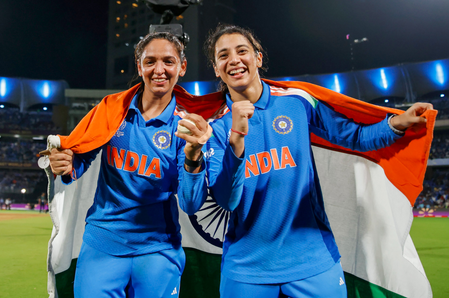




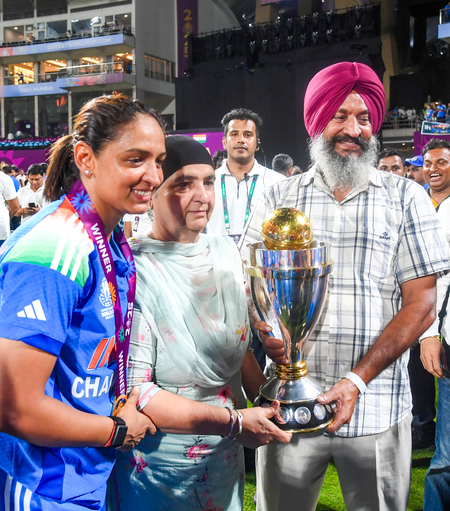
New Delhi, Oct 9 (IANS) Former India captain Anjum Chopra believes Harmanpreet Kaur’s biggest legacy as the side’s skipper will be the 2025 Women’s ODI World Cup triumph on home soil, adding that she has left the team as a far stronger, more experienced and more confident side than the one she inherited.
Harmanpreet stepped down as India captain across formats this week after nearly a decade in charge, and Smriti Mandhana has been named her successor. Harmanpreet captained India in five Tests, 51 ODIs and 155 T20Is and signed off from her tenure by leading India to their second consecutive Asian Games gold medal in Nisshin, Japan last month.
“The biggest legacy Harmanpreet will always have to her credit as a leader is winning the ODI World Cup in 2025. Look at how her batting shaped up in that tournament – in the league games, the semifinal, and the final, and how the team evolved to get there through everyone’s contribution. It wasn’t just Harman. With every player contributing, Harman was able to lift that crown and India was able to win.
“Harman has grown in stature alongside this team, especially over the last three and a half years since taking over the ODI captaincy. Earlier, we played T20s far and few between with more one-day games on the schedule. In recent years, that shifted to where almost every bilateral tour includes T20s, sometimes even more than ODIs.
“I’ve seen her grow into that leadership role, and her legacy will always be measured by where she took the reins to where she leaves them. In the one-day format, the Indian team are world champions. They are a far stronger, more energised, skillful, and experienced unit than when she took over.
“That will be her legacy, alongside the aggression and confidence she brought into that dressing room over the years. If those qualities are carried forward, this Indian team is on the right path and the process is well set,” Anjum told IANS in an exclusive conversation on Friday.
Anjum, who has known Harmanpreet since meeting in a training camp in 2008, felt the persona behind the former captain has stayed the same through years of drastic changes in the women’s game. “I’ve thought through this question so many times in the last 48 hours. What is that one memory? It will not be just one memory.
“Yes, I’ve seen her from the closest proximity of being a part of the Indian team, even before she became a member in the 2008 training camp, from there to playing her first World Cup match against Pakistan in 2009 till date. I’ve seen Harmanpreet grow as a player, and I’ve seen Harmanpreet grow as a captain.
“You only get wiser with every passing day, so she has also grown in stature and age. It has been a very balanced approach from what I’ve seen. I say this without bias: having seen Harmanpreet from close quarters to what I see today, whether in the last T20 World Cup or whenever our last conversation happened, I don’t think the person Harmanpreet Kaur has changed, even though things around her have changed dramatically for the women’s game.
“I have never seen an impulsive side in her. From those days, I’ve always seen a calm demeanour in Harmanpreet Kaur. As a captain, if somebody makes an ordinary effort in the field – like failing to stop a ball, not throwing it back quickly, or conceding an extra run – she will give that person a go right on the ground, whether the cameras catch it or not.
“But the moment that same person makes a good stop, takes a wicket, or takes a catch, she will be the first person to run across and compliment them. I’ve seen both sides of skipper Harman over the years. Harmanpreet as an individual hasn’t changed, and that’s the beauty of it. That reflects in the team, in her persona, and in every aspect of a leader. Probably that’s also the biggest highlight of Harmanpreet’s tenure at the helm as captain of the Indian team,” she elaborated.
Asked on when the side became unmistakably hers, as India evolved from being underdogs to serious contenders for winning global events, Anjum said, “It’s changed because we’ve started seeing results in a positive way. I’m not saying that earlier captains didn’t give results, but when Harman took over, even in the 2018 World Cup in Guyana, I remember very clearly the first match against New Zealand where she scored a hundred – it was the first hundred for an Indian in a T20I.
“You could see it in the approach, body language, and it’s not just with Harman – that goes for any leader in this mould. We’ve had leaders in the past and we will have leaders in the future. It’s also about an individual’s persona and character. How they are and how they play the sport got reflected in the Indian team as well.
“When she took over, the team had a few senior players playing alongside, but they were constantly changing. But this team has grown and Harman has grown with this team. That’s why those near misses always hurt – she was always in the thick of things as a leader and captain. If you read and observe it, I’ll say from the time she took over all-format captain – that was in 2022 (after Mithali Raj retired).
“It was very evident that this is Harmanpreet Kaur’s team and she is the one who is holding the fort. I won’t say calling the shots. I’ll say holding the fort. To me, it was very much visible that it was Harmanpreet Kaur’s team.”
India’s journey to winning the 2025 ODI World Cup title came after a string of near misses at global events, and Anjum felt a captain can only take a team at a pace it is able to follow. “It’s about making sure the team believes in that as well – it’s not just one person. I saw how India let go of the World Cup in 2017 at Lord’s. In 2020, they were still getting their act together in T20 cricket.
“2023 was a near miss against Australia in that semifinal game, and in 2024, they were underprepared when they played in the UAE. After all these journeys, Smriti has been around for such a long time and played so many World Cups. Deepti has been around for a long time, and Jemimah has been part of World Cups since 2018.
“That experience has been there, but as the simple saying goes: the speed of the leader is the speed of the team. The leader has to be right in front, and only at that speed will the team follow. You can’t be a quick leader if the team isn’t following.
“The moment you take up a role, you have to understand what you want, but before that, you have to understand what pace you can run at and what pace the team can run at. It has to be that balancing act.”
She also rejected the argument that India’s early exits from the last two T20 World Cups, in 2024 and 2026, led to Harmanpreet stepping down as captain. “I’ll be brutally honest here. Captaincy can change things because it’s leadership, but in Indian cricket, and largely in Indian sports, a captain’s tenure is never clearly defined. It can be long, or it can be short. We’ve even seen someone captain on debut.
“If I have to answer this question about the exits in the two T20 World Cups, I don’t think the team was equipped to handle the opposition. Whether it was in the UAE or in England, we have the same set of players playing both 50-over and T20 cricket, using the same template. Look at the matches closely in the UAE and in England – I’m not saying only Harman, Smriti, or Deepti were scoring, but look at the template and style of cricket.
“A captain does not decide that style of cricket; individual players decide that style by how they go out and play. Nobody tells you to settle for 150, 160, or 170. For the last two to two-and-a-half years, 200 in a T20 game has become a standard par score, even in women’s cricket. When you get to a World Cup, you expect a minimum score of 180 or 190, sometimes even more. If these same Indian players are scoring 200 or chasing down 220 in franchise cricket, why does that template not get replicated at a T20 World Cup?
“It has to be replicated. If it’s not, that means either the preparation is incomplete, the confidence isn’t there, or you’re unable to execute it for some reason. You can’t be chasing 200-plus in a WPL match and then struggle to reach 150 or 160 convincingly on the international stage. So it isn’t a captaincy issue. I could understand blaming captaincy if tactical decisions were incorrect or if there was favouritism.
“I’ve constantly said, even before the start of the 2025 World Cup, that India is short of bowling reserves. Shafali had to be brought in to take those two wickets to secure a victory. I’m very happy we won that World Cup, but we were still short on bowling depth. Even today, we play with one fast bowler like Kranti Gaud, and Nandini Sharma has just walked in.
“If changing captaincy guarantees ICC trophies, then change it every tournament – no harm in that. Nobody would complain – not me, not my seniors, nor the current Indian team. If it meant winning an ICC trophy, we could have a new captain every tournament. But the template has to be set by the players, not the captain. It is set individually by the batters, bowlers, and wicketkeepers and that is where the Indian team faltered, both in 2024 and in 2026.”
On why Harmanpreet has spoken often of sacrifice in her Instagram post while announcing her resignation, Anjum offered a deep explanation into it. “The biggest sacrifice you make is setting aside your own desire and will to play a certain way. Sometimes you want to bat at number three, but the team requires you to bat at four or open, so you take up that difficult role.
“You have to put the team’s interest ahead of your own. You might want to bowl or not want to bowl, or the team might need you stationed on the boundary line – those are small things. But largely, sacrifice comes from understanding that the team’s interest comes first. The common interest is that the team has to win, but how?
“Either the team walks through the door first, or you as an individual walk through first. That is how small and large decisions are made – decisions made very frequently in squad selection, playing eleven selection, and determining who bats where and when. How much time do you feel a player needs versus what the management feels?
“You might want a certain setup that isn’t agreeable to everyone else. How do you understand a younger player’s role when team dynamics make it hard to balance? All those areas are sacrifices because you wake up first and go to sleep last. Even in your dreams, you’re thinking about how everyone else is doing. What more can I do as a player and leader so everyone walks onto the park with a smile? These things aren’t easy and they take a lot out of you.
“That’s why you see a captain age quicker in their first couple of years. Even if you’re winning, captaincy is time-consuming and energy-draining. It’s a responsibility, and until you are in that decision-making role, you don’t fully understand it. You can never truly prepare for it – you can only wish to be there, but once you are, you are surrounded by so many things.
“That’s why ‘sacrifice’ is a word she has used very often. When I read it, I thought there must be a bit more weight behind that word considering her post. In time to come, I’m sure we’ll get to know more. But from a captain’s perspective, it’s not an easy job. It will never be an easy job, and it shouldn’t be – that’s why captains are so highly valued. It’s a moving entity – the Indian team will always keep moving. It will never stop, it will never be stagnant, and it will always undergo that change of leadership at the helm.”
–IANS
nr/bc