New Delhi, Oct 8 (IANS) The Taliban, driven from power by a US-led invasion that began October 7, 2001, is once again the ruler of Afghanistan, and Washington finds itself engaging with the same movement over issues ranging from prisoners’ release to the fate of billions of dollars’ worth of military equipment left behind during its military withdrawal in 2021.
When the US troops withdrew from Afghanistan, they left behind armaments and vehicles that today remain in contention between Kabul and Washington.
It has been 25 years since the invasion by a United States-led coalition in response to the September 11 attacks (9/11) carried out by Al Qaeda. The war began with NATO forces launching Operation Enduring Freedom against Taliban-controlled Afghanistan. The immediate objective was to dismantle Al Qaeda, whose leader, Osama bin Laden, had orchestrated 9/11 reportedly from Afghan territory under the-then Taliban’s protection.
What began as an air campaign was followed by America’s longest war of over two decades, with successive US administrations pouring vast military, political, and economic resources into rebuilding Afghanistan and maintaining security. International donors funded roads, schools, hospitals, telecommunication networks, and government institutions.
Afghan children, including girls barred from education under Taliban rule, entered schools. New universities emerged, private media flourished, and Kabul was transformed from a battered capital into a rapidly expanding city with office buildings, shopping centres, fast food outlets, and modern infrastructure.
Despite these visible changes, the war never truly ended. The Taliban regrouped and steadily expanded its influence, especially in rural areas, expanding through provinces. The resurgent Taliban was said to have been supported by Al Qaeda and Islamic State Khorasan Province (ISIS-K), among other militant groups. By the late 2010s, Washington increasingly sought a negotiated exit from the conflict.
That effort culminated in the Doha Agreement signed on February 29, 2020, between the United States and the Taliban during President Donald Trump’s first administration. The accord committed Washington to withdraw all foreign forces in exchange for Taliban counterterrorism guarantees and participation in negotiations within Afghanistan.
Notably, the accord was signed in Doha by Taliban leaders, and some reports claimed that the Afghan government was not a direct party to the agreement. Under the pact, US troops were reduced significantly, while air operations against the Taliban also declined.
This allegedly led to weakening the morale of the then-Afghan security forces and contributed to a growing sense that the United States was preparing to leave regardless of ground conditions.
President Joe Biden ultimately implemented the final withdrawal. After sweeping through provincial capitals, Taliban fighters finally entered Kabul on August 15, 2021.
No country has granted official recognition to the current administration in Afghanistan except Russia, though many maintain relations over security interests and supply humanitarian aid.
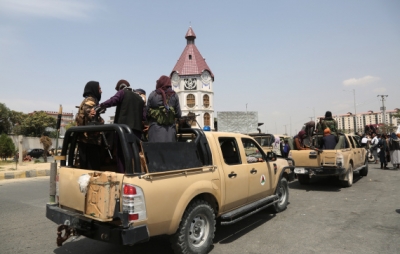
According to Pentagon assessments, equipment worth approximately $7 billion, including aircraft, vehicles and hundreds of thousands of weapons, ultimately fell into Taliban hands, say reports. The group has since displayed much of the equipment in military parades and now reportedly uses some of it for security operations.
Today, Washington continues to engage Kabul’s present regime over the fate of detainees and armament, even as it refuses to formally recognise the government.
Following the release of American academic Dennis Coyle earlier this year, reports quoted US officials that efforts were ongoing to secure the return of at least two other Americans.
Afghan media reported last month that according to Kabul, military equipment left behind by US forces is now the property of the government and that Afghanistan is not seeking to negotiate or bargain over it.
Responding to US demands for the return of the equipment, Qahar Balkhi, spokesperson for Afghanistan’s Foreign Ministry, reportedly said that the United States killed many people in the country during the war and destroyed large parts, and should pay for the consequences of its actions.
A quarter-century after American bombs first struck Taliban positions, the movement the US once sought to destroy governs Afghanistan again, leaving Washington negotiating with the regime it clearly declares as not having recognised.
–IANS
jb/vd