




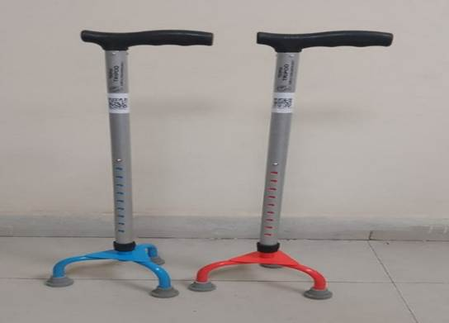
New Delhi, May 1 (IANS) The six new Bureau of Indian Standards (BIS) for medical assistive technologies, part of the NLEAP (National List of Essential Assistive Products) initiative brought about by Indian Council of Medical Research (ICMR), aim to serve as a guideline for policymakers, healthcare providers, and the concerned stakeholders for provision of assistive products as well as support the development of assistive technologies across the country, the government said on Friday.
Standards for ‘elbow crutches’ specifies requirements and test methods, fully equipped with handgrip and tip including requirements relating to safety, ergonomics, performance, and information to be supplied by the manufacturer, including marking and labelling.
New Standards for ‘walking sticks’ covers the requirements pertaining to material, shape, dimensions, workmanship, finish and performance of walking sticks (including wooden, cane, aluminium, plastic and rubber).
This is an indigenous standard developed after consultation with the technical experts from the Indian industry, said Ministry of Consumer Affairs, Food and Public Distribution.
Moreover, the Standards for ‘Walking sticks’ specifies requirements and methods of walking sticks with three or more legs and fully equipped with handle and tips. It also gives the requirements relating to safety, ergonomics, performance, marking and labelling.
The Standards for ‘Accessible Design’ explains what information tactile guide maps should include and how they should be designed and displayed. These maps help people who are blind or have low vision understand buildings (like public places, transport areas, and parks) and nearby routes, so they can move around safely and easily, according to the ministry.
Another ‘Accessible Design’ Standards specifies the fundamental requirements for braille used on signage, equipment and appliances, including the dimensional parameters of braille and the characteristics of materials used, and the guidelines for practical implementation.
The ‘portable ramps’ Standard specifies the requirement for ramps for wheelchair users, as well as people pushing strollers, carts, or other wheeled objects, to more easily access steps, buildings, and other transportation systems.
This standard is applicable to portable ramps used for people with a range of mobility problems using powered or manual wheelchairs, mobility aids, older people, and children on with or without assistance of a caregiver to improve freedom of movement around a variety of environments, including the home, place of work, or local community.
“There is a growing need for standards in the area of Assistive Products that are crucial for enhancing the quality of life and promoting independence among individuals with functional impairments. By developing standards aligning with the global practices and their compliance would ensure that products of Indian Domestic Manufacturers meet international quality benchmarks and eligible for export to international markets,” said the statement.
–IANS
na/