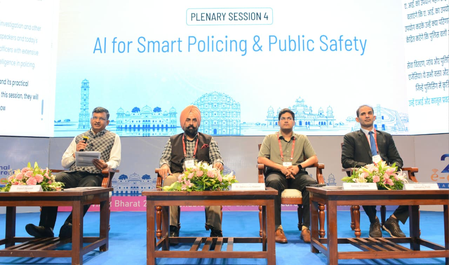
Jaipur, July 2 (IANS) Artificial Intelligence (AI) is rapidly transforming policing by shifting law enforcement from a reactive model to a preventive one, leading to faster emergency response and improved crime prevention, experts said during a plenary session at the 29th National Conference on e-Governance in Jaipur on Thursday.
The session, titled “AI for Smart Policing and Public Safety”, was held on the second day of the conference at the Rajasthan International Centre and was chaired by Gopesh Agrawal, Bureau of Police Research and Development’s (BPR&D) Additional Director General of Police.
Addressing the session, Agrawal said police forces across India are increasingly adopting AI-powered technologies to improve law enforcement and public safety.
He added that AI is helping transform policing from responding to crimes after they occur to preventing them before they happen, resulting in lower crime rates and quicker emergency responses.
Emphasising the role of technology, Agrawal said that AI should not be seen as a replacement for police personnel but as a “force multiplier” that enhances their capabilities.
Speaking during the session, Amandeep Kapoor, BPR&D (Jaipur) Director, stressed the need for strong safeguards to prevent the misuse of AI.
He highlighted emerging technologies such as blockchain, data computing, Crime and Criminal Tracking Network and Systems (CCTNS) 2.0, e-Sakshya, Agentic AI, Edge-based Large Language Models (LLMs), the Mule Hunting app, and dark web monitoring, describing them as key tools for strengthening modern policing.
Kapoor said that India should focus on developing sovereign, responsible and indigenous AI to ensure secure and reliable implementation.
He added that BPR&D is working on training programmes and system development to support AI adoption in policing.
Panelist Kommi Kishore, Eluru (Andhra Pradesh) Superintendent of Police, said that AI literacy has become essential for police personnel.
He pointed to AI-powered investigative tools, including language translation technologies, which have improved investigations and contributed to better conviction rates.
Kishore cautioned that AI should be adopted in a balanced and phased manner, warning that rapid, unregulated deployment could create risks such as algorithmic bias in investigations.
“The objective of AI in policing should be to make policing proactive, not merely predictive,” he said.
Another panelist, Salman Taj, Hyderabad-based Central Detective Training Institute (CDTI) Director, said that policing data is currently scattered across multiple platforms, making investigations more challenging.
He advocated establishing Data Fusion Centres to integrate information into a single system, enabling faster and more accurate investigations.
Taj also highlighted the importance of AI data sovereignty, saying secure data management is critical for the responsible use of artificial intelligence in law enforcement.
The session concluded with an interactive discussion between experts and participants on AI-driven policing and emerging technologies.
Vijay Kumar Singh, Additional Director General of Police (Law and Order) of Rajasthan Police, felicitated the speakers with mementos.
The discussions underscored the growing role of AI-based smart policing, secure digital infrastructure, responsible technology adoption and data-driven investigations in strengthening India’s policing and public safety framework.
–IANS
arc/khz