



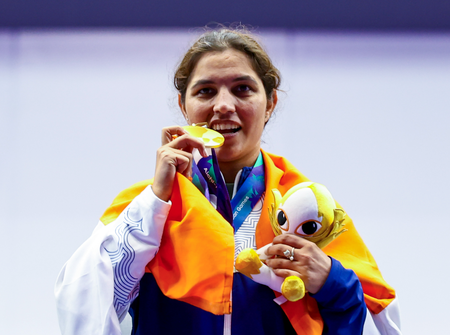
Nagoya, Sep 30 (IANS) Neeru Dhanda’s Asian Games campaign had been in doubt barely days before she arrived in Aichi-Nagoya, but the Indian trap shooter overcame an illness, won individual gold, added a team silver and then partnered Kynan Chenai to mixed team gold on Wednesday.
Looking back at the journey, Neeru said the biggest memory would not be a particular shot or medal ceremony, but the preparation and recovery that made it possible for her to compete at all.
Neeru and Kynan entered the mixed team medal round in fourth place before fighting their way to the gold medal, defeating Qatar in the title contest. The victory completed a remarkable medal haul for Neeru and made her one of the standout Indian performers in the shooting competition.
Despite the significance of becoming the first Indian woman to win an individual Asian Games gold in trap and then adding two more medals, Neeru said she has not yet had the opportunity to fully process the achievement.
“No, it doesn’t feel like just another competition, but yet, I haven’t really had that moment where it has sunk in that I’ve won the elusive gold. I haven’t had the time to sit alone and truly take it in, to feel that I’ve achieved what I had imagined. So far, that feeling hasn’t really come to me, either physically or mentally. I haven’t had much time to sit and think about the win,” told IANS in an exclusive conversation.
That reaction becomes more striking in the context of what Neeru had been dealing with before the Games. She had spent days recovering from illness, with her participation itself uncertain, before eventually making it to the competition.
“At that time, I had to keep myself motivated. Firstly, I needed to focus on improving my health. After that, I would think about what came next. But my coach pushed me, kept me motivated, and told me about his experiences in the competition and the difficulties he faced. He said that after an illness, once you recover, you feel fresh again. He told me to take care of myself, eat well, and remind myself that I had trained for a whole year and had been training continuously for the past five or six years for a purpose, for a reason. So, these four or five days can’t shake me. It wasn’t that I couldn’t concentrate. That was what motivated me, and my coach played a big part in it at the time,” the double gold-medallist said.
Her mixed team gold came after a contest in which the Indian pair had to recover from a modest qualification showing. With communication restricted while they were shooting, Neeru said Kynan’s gestures and a brief conversation during a technical interruption helped reinforce the message to remain patient and focus on execution.
“When we’re out there, we’re unable to talk, but he constantly gestured to push me; he said I have to fight, I have to fight till the last shot. I got a little gap when there was a technical fault; we talked a little about how I have to fight, and I don’t have to think too much; I think of one shot at a time. So, we were discussing the process and how to do it,” Neeru expressed.
The mixed team gold completed a medal sequence that began with Neeru’s individual triumph, followed by silver in the team event alongside Aashima Ahlawat and Manisha Keer.
Asked to distinguish between the three medals, Neeru emphasised that each required a different kind of contribution.
“In the individual event, the role of the final is more important. How to fight in the final. And in a team event, the contribution of the whole team is more important. For example, I was doing well, but my teammates were pushing me a lot to do well. That didn’t go well one day, but the next day they helped me with a lot of effort. And we contributed to each other. The medal is for the team and for the team. And they were also constantly pushing me a lot in the individual event and played a big role in me winning the individual gold. And in the mixed team, I have a senior as my pair. He was already pushing me. So, yeah, that’s the story,” she stated.
Neeru also credited the wider Indian shooting system, including the NRAI, Sports Authority of India and the coaching staff, for creating the environment in which the team could prepare and compete.
“The whole federation has contributed. We’re using everything the NRAI has provided to move forward. The federation supports us at every level. We used to get one camp a year; now we get two or three. The players’ needs also matter. Who do we need on staff? How many physios and psychologists do we need? The federation provides all of this, including the coach. We discussed this last year with the federation and SAI, and then they hired Peter Wilson as our coach. It was all because of their support and backing. There has been a lot of improvement, and the federation has played a role in everything. The federation helps us a lot, and the coach, obviously, is very smart!”
Her relationship with Kynan also offered an important link between experience and a newer generation of Indian trap shooting. Neeru said she found similarities in their approach, particularly through their connection with coach Mansher “Joey” Singh.
“I really like his process. The way I do things easily, I think it’s similar to him as well. The way I execute my breathing. I think that’s the strongest thing. His coach, who is my coach now…he had the same coach in 2016 when he went to the Olympics. So, Mansher (Mansher “Joey” Singh) sir was his coach. So, the way he has been taught, the same things are being taught to me. So, things are really very similar. I feel that he is doing so well and I slowly started following him and now we’re here,” Neeru said of Kynan.
But when asked what she would remember most about Aichi-Nagoya years from now, Neeru returned to the period before she even reached the shooting range.
“I will always remember the preparation that went into winning this medal. I will never forget it. I will always remember how I won this medal, coming here after going through such difficult circumstances and recovering from an illness. At one point, I was just thinking that somehow, I had to make it there. That will be my biggest memory because never in my life had I been so sick that I had to wonder whether I would even be able to compete. And this is the first gold medal of my life, two gold medals and one silver. So I will always remember how I won this medal and the things that went into winning this medal beyond the shooting range,” the trap shooter concluded.
–IANS
vi/bsk/