




CANBERRA, SEPTEMBER 9/INDIAN ABROAD NEWSDESK
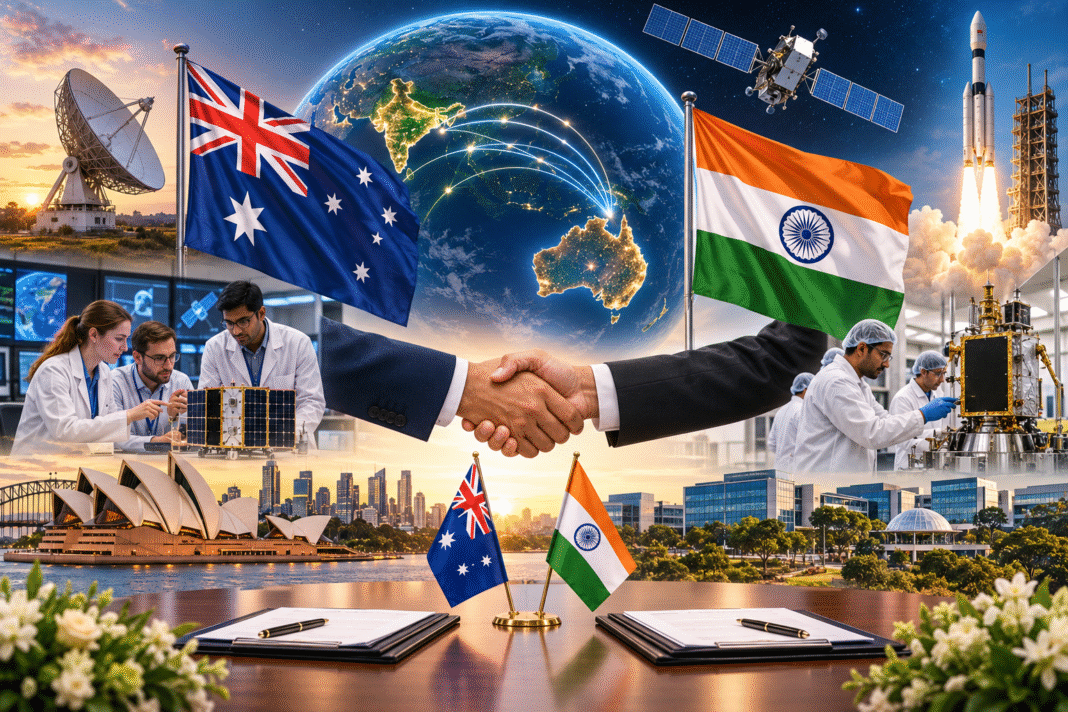
Australia and India are taking their space partnership into a more commercial phase, with five new industry agreements bringing companies and research institutions from the two countries together across satellite communications, research and development, and launch and re-entry technologies.
The Hindu Businessline reported that the agreements were concluded during an Australian business delegation’s engagement with India’s expanding private space sector. Nathan Davis, Trade and Investment Commissioner, Austrade, New Delhi, shared details with Businessline on the sidelines of the ninth Bengaluru Space Expo.
One of the agreements brings Australian satellite communications company LatConnect 60 together with NewSpace India Ltd (NSIL). In another collaboration, the University of Western Australia and the Space Industry Association of India (SIA-India) will work together in research, development and education.
Australian launch and re-entry company Space Machines has entered into three separate partnerships with Indian companies Angel Technologies, Red Balloon Aerospace and Inbound Aerospace, further widening industry-to-industry links between the two countries.
The latest agreements add to an established institutional framework for Australia–India space cooperation, including a memorandum of understanding between the Australian Space Agency and ISRO. Space and technology have also been identified as important areas for deeper collaboration under the broader strategic partnership between the two countries.
Davis told Businessline that India’s private space industry had undergone significant growth over the past six to eight years, creating stronger opportunities for Australian companies and investors. He said the sector was attracting increasing private investment, while government support remained important for developing deep-technology and space capabilities.
Australia has committed around A$20 million through grants for Australian companies working with Indian organisations. Its National Reconstruction Fund is also providing a pathway for investment in Australian space companies, according to the report.
The scope of potential cooperation is also expanding beyond space. Davis identified critical minerals and rare earths as another emerging opportunity, particularly in processing, refining and long-term offtake arrangements.
The growing network of commercial partnerships signals a broader evolution in Australia–India ties, with private companies, investors and research institutions increasingly becoming part of the relationship. Space, critical minerals and advanced technology could emerge as key sectors in the next phase of bilateral economic cooperation.