




BRISBANE,
November 10
Indian Abroad Newsdesk
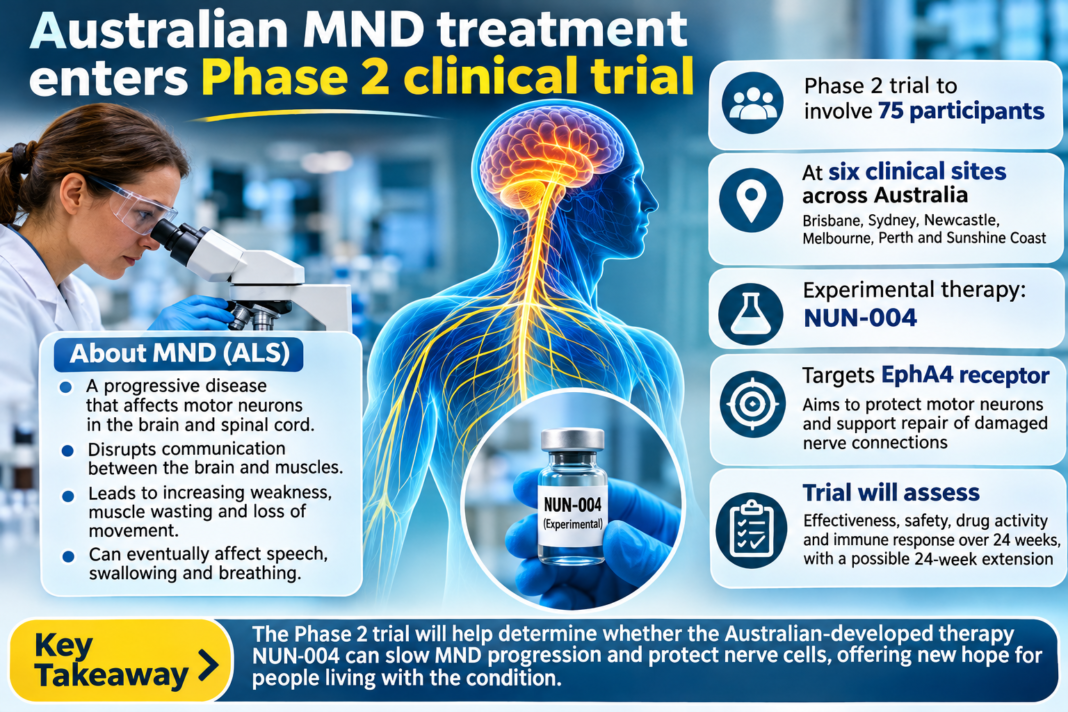
An experimental treatment developed in Australia for motor neurone disease (MND) is moving into a Phase 2 clinical trial involving 75 participants, as researchers seek to determine whether it can slow the progression of the debilitating neurological condition and protect the nerve cells responsible for movement.
According to a November 10 announcement by Queensland-based biotechnology company NuNerve, the experimental therapy, known as NUN-004, will be evaluated at six clinical sites across Australia. The trial follows an earlier investigation that produced encouraging preliminary observations among a small group of people living with MND.
The University of Queensland, which reported the development through its official news service, said the treatment emerged from more than 25 years of research conducted by Emeritus Professors Perry Bartlett and Andrew Boyd at the Queensland Brain Institute. The research focuses on understanding how nerve cells communicate, survive and repair damaged connections.
According to NuNerve, NUN-004 is a long-acting, protein-based experimental therapy designed to target EphA4, a receptor associated with the development and functioning of nerve connections. Researchers believe excessive signalling through this receptor may contribute to motor neuron degeneration and interfere with the repair of damaged neural connections.
Professor Bartlett, Chair Emeritus of NuNerve, said the research was intended to explore an approach that goes beyond conventional efforts to slow the loss of physical abilities. He explained in the company’s announcement that the treatment was designed to protect motor neurons and create conditions that could support the repair of damaged connections. However, the ability of the therapy to achieve these outcomes remains to be established through clinical testing.
MND, also known as amyotrophic lateral sclerosis (ALS), is a progressive disease affecting motor neurons in the brain and spinal cord. According to the University of Queensland’s explanation of the condition, the gradual deterioration of these nerve cells disrupts communication between the brain and muscles, resulting in increasing weakness, muscle wasting and loss of movement. The disease can eventually affect speech, swallowing and breathing.
According to the registered study protocol, participants will initially be randomly assigned to receive either NUN-004 or a placebo for 24 weeks. The allocation will follow a two-to-one ratio, with participants and relevant research personnel remaining unaware of the treatment assignment during this period. Eligible participants may subsequently enter a 24-week extension in which they receive the experimental therapy.
Researchers will measure changes in disease progression using the ALS Functional Rating Scale-Revised. The assessment will be supported by examinations of respiratory function, nerve activity, quality of life, safety and relevant biological markers.
According to NuNerve, the earlier Phase I/Ib investigation involved 20 healthy volunteers and eight people with MND. The company reported that the treatment was generally well tolerated and that some participants experienced periods of disease stabilisation and improvements in activities involving walking, balance, grip and muscle strength. These observations are preliminary and do not establish that the therapy can reverse the disease.
Sunshine Coast Health, one of the participating health services, confirmed that the 75-person trial would include a clinical site on the Sunshine Coast, alongside locations in Brisbane, Sydney, Newcastle, Melbourne and Perth. Associate Professor Antony Winkel, Medical Director of Stroke and Neurology at Sunshine Coast Health and NuNerve’s Clinical Lead, said the research would help determine whether the early observations represented a genuine treatment effect.
The University of Queensland also acknowledged the contribution of its commercialisation company, UniQuest, which helped establish NuNerve to take the university research towards clinical development. According to NuNerve, the programme has received three consecutive grants from Australian research organisation FightMND.
The advancement represents an important stage in Australian neurological research, but the treatment remains experimental. The Phase 2 findings will be essential in establishing whether NUN-004 provides measurable benefits.