



CANBERRA, SEPTEMBER 9/INDIAN ABROAD NEWSDESK
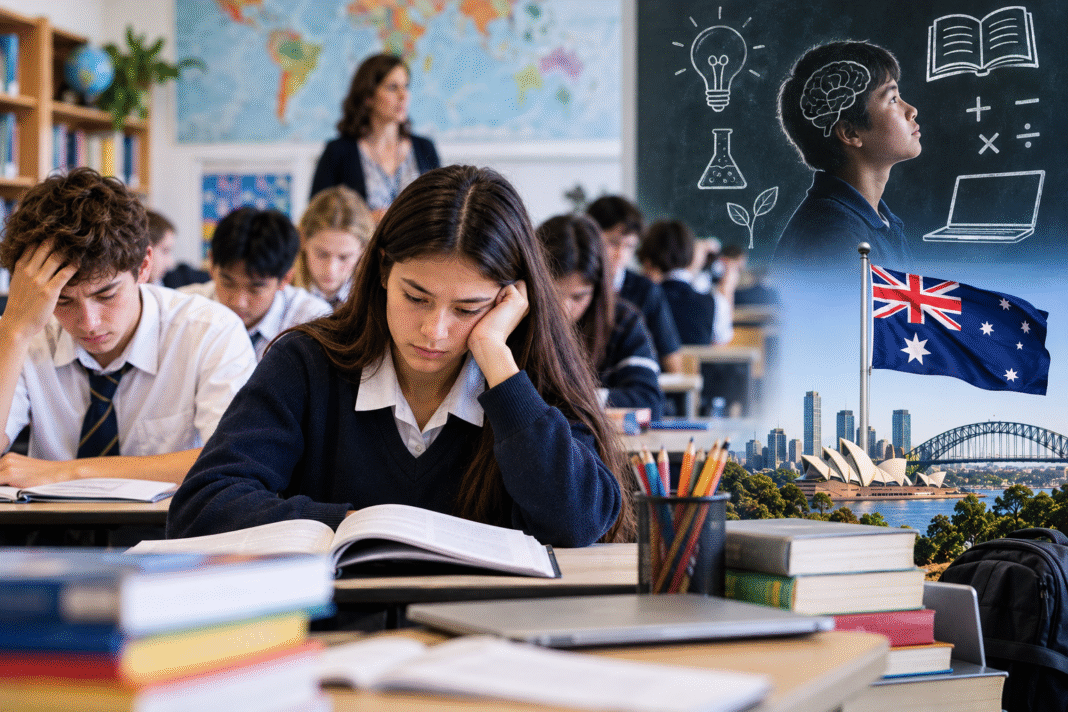
Australian students have recorded their weakest-ever results in reading and mathematics in the latest international education assessment, renewing concerns about a prolonged decline in learning outcomes despite the country continuing to perform above the OECD average.
The results from the 2025 Programme for International Student Assessment (PISA), released by the Organisation for Economic Co-operation and Development (OECD), show that Australian 15-year-olds scored 491 points in reading and 478 in mathematics. Science was comparatively stronger at 509 points. The Australian Council for Educational Research (ACER), which administers PISA in Australia, said the science result remained broadly stable while reading and mathematics continued their long-term downward trend.
The assessment covers 91 countries and economies and involved about 760,000 students globally. In Australia, 14,658 students from 766 schools participated, representing about 275,000 15-year-olds nationally, according to ACER.
The latest figures underline the scale of the deterioration over the past two decades. ACER said Australia’s reading score has fallen 37 points since the first PISA assessment in 2000, while mathematics has dropped 46 points since testing in that subject began in 2003. Mathematics also fell nine points between 2022 and 2025, while reading declined by seven points over the same period.
The OECD has reported a broader deterioration across developed education systems, with average mathematics performance among OECD countries falling 22 points between 2015 and 2025 and reading declining by 28 points. The organisation said the latest results represented the lowest OECD average performance recorded in the three core PISA subjects.
Australia, however, remains above the OECD benchmark in all three areas. The Australian average of 509 in science compared with an OECD average of 482, while the reading score of 491 was above the OECD’s 461 and the mathematics result of 478 exceeded the OECD average of 463.
ACER said Australia ranked among the stronger-performing education systems, placing 10th in science and reading and 16th in mathematics when comparing countries that participated in both the 2022 and 2025 assessments.
Jonas Bertling of ACER said the results pointed to sustained weaknesses in reading and mathematics but noted that Australia’s science performance had remained comparatively steady.
The distribution of results is also a concern. ACER reported that 60 per cent of Australian students reached the national proficient standard in science, compared with 55 per cent in reading and 49 per cent in mathematics. In mathematics, 29 per cent were classified as low performers, while only 10 per cent reached the highest performance levels.
Education policy analysts have also raised concerns about what is happening inside classrooms. ABC News reported that Australian students’ responses indicated continuing problems with classroom disruption, even though the reported disciplinary environment had improved from earlier assessments. Forty-one per cent of students said their classrooms experienced noise and disorder, compared with 31 per cent across the OECD. A further 21 per cent said they could not work well in most or all lessons, against an OECD figure of 19 per cent.
Attendance is another area of concern. According to ABC News’ reporting on the PISA findings, 44 per cent of Australian students said they had missed at least one day of school during the two weeks before the assessment, almost twice the OECD average of 24 per cent.
Blaise Joseph of the Centre for Independent Studies described the longer-term pattern as troubling, pointing to a combination of fewer high-performing students and a growing proportion struggling across the three core subjects, ABC News reported.
Federal Education Minister Jason Clare said the findings reinforced the importance of changes to classroom teaching and increased funding for public schools. He pointed to the United Kingdom’s education reforms as an example of how sustained policy changes could influence international results over time, according to ABC News.
Technology has emerged as another part of the education debate. Clare said schools needed to ensure students developed digital capabilities, including understanding how to use artificial intelligence appropriately, while also questioning whether students were spending too much time using screens during school hours.
The PISA results provide some encouragement in this area. Australia’s strongest performance came in the newly assessed Learning in the Digital World domain, which examines students’ ability to learn and solve problems in technology-rich environments. Australian students achieved an average of 532 points, well above the OECD average of 500, and 75 per cent reached Australia’s national proficiency standard.
The OECD’s broader analysis suggests that technology’s effect on learning is not straightforward. Moderate use of digital tools can support learning, while excessive use and classroom distraction can be associated with weaker outcomes. The issue is therefore increasingly shifting from whether technology belongs in schools to how effectively it is incorporated into teaching.
For Australia, the PISA findings present a mixed picture: students continue to perform better than the OECD average and show particular strength in science and digital learning, but the prolonged decline in foundational reading and mathematics skills remains a significant challenge. The results are likely to keep education quality, classroom practice, attendance, technology use and teacher support at the centre of Australia’s education policy debate.