




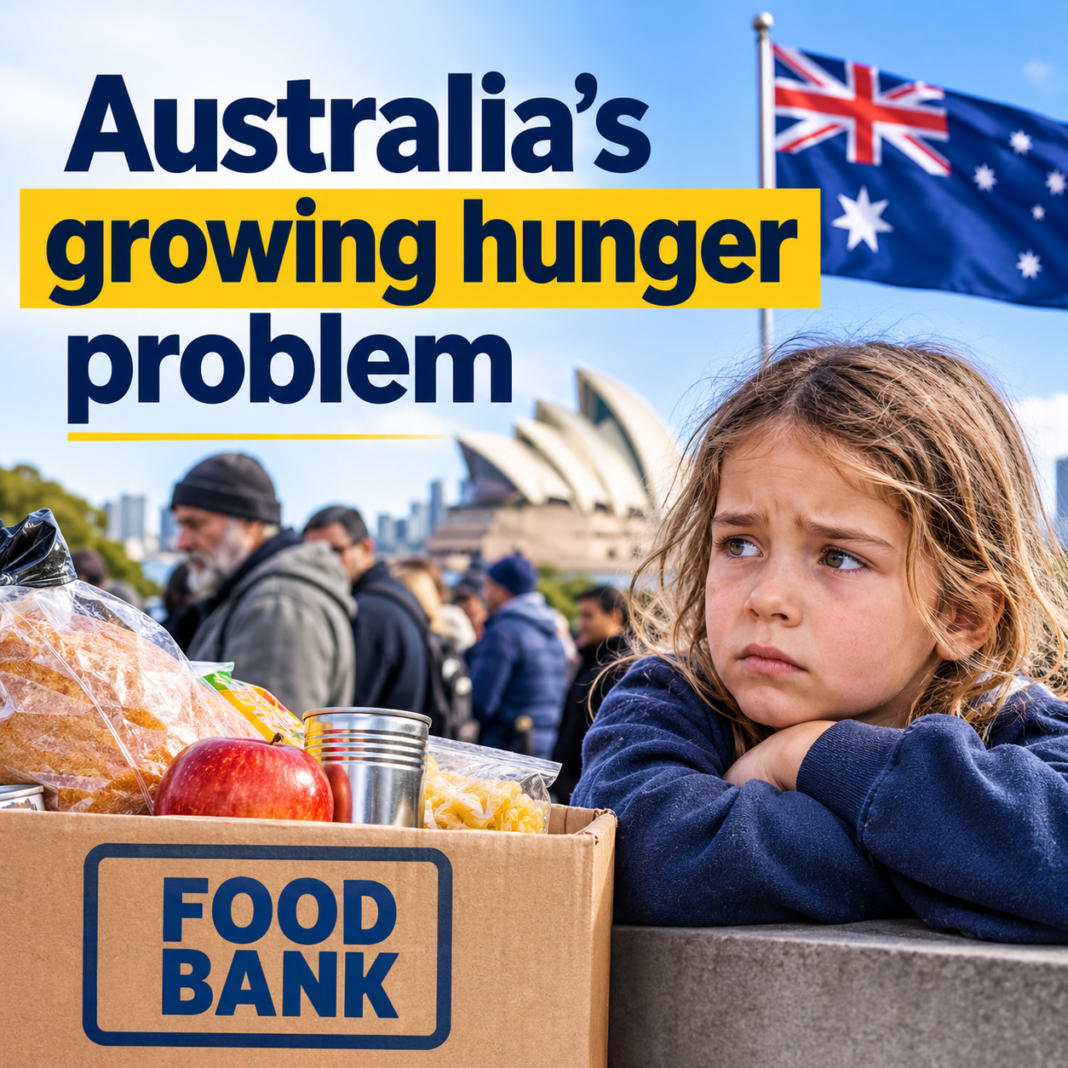
Australia does not have the problem of shortage of food. The fact is to the contrary. Any assessment of its farms’ produce will show that the country produces enormous quantities of agricultural commodities. A visit to its supermarkets will ensure that these are well stocked. There is not only more than enough to feed the households in Australia but also surplus produce that the country has been exporting to other countries. Will it then not become interesting to know that here is a country with plenty, yet it is also a fact that an increasing number of Australians are struggling to afford a proper meal? There is something amiss somewhere in Australia about this situation. Logic says that a country that boasts of such agricultural resources and economic capacity, would in all probability not have families worrying over whether it would get its next meal.
A study of the Foodbank Hunger Report 2026 presents a disturbing picture. It says that nearly 3.6 million Australian households, or one in three, experienced food insecurity during the preceding 12 months. Now the findings are particularly worrying when one considers that nearly 70 per cent of those affected said they were experiencing food insecurity for the first time. This suggests that financial hardship is reaching households that may never previously have needed assistance from a food charity.
The food insecurity aspect in Australia is different from that in India. For many people in Australia, food insecurity does not necessarily mean going without food every day. Rather It is about making small compromises insofar as families stop buying fresh fruit and vegetables, reduce their purchases of meat and other protein-rich foods, or choose cheaper products to make their grocery budget last longer. But there are some who have had to skip meals altogether, while others go an entire day without eating. Over time, these compromises may have affected physical health and general wellbeing adversely.
The situation becomes particularly difficult when children are involved. According to the report, around 45 per cent of households with children experienced food insecurity. In many families, parents are eating less so that their children can have enough. Single-parent households are among the worst affected, with about seven in ten experiencing food hardship.
One can imagine the pressure on a parent who has to decide whether to eat or leave the food for a child. Such decisions are made quietly in many homes. Children may not always understand why their parents are missing meals, but they can certainly feel the strain within the family.
Another important finding is that food insecurity is no longer confined to people on very low incomes or those dependent on welfare payments. Working Australians are increasingly finding themselves in difficulty. The report indicates that 37 per cent of middle-income earners in the income bracket of up to $100,000 experienced food insecurity. Having a job and earning a reasonable salary no longer guarantees that a household can comfortably meet its basic needs.
Housing costs are a major reason behind this growing pressure. While food insecurity affects about 12 per cent of people who own their homes outright, the figure rises to 51 per cent among renters. A family paying a large part of its monthly income towards rent has very little room to manage unexpected expenses. When electricity bills, transport costs and other payments arrive, groceries are often where families begin cutting back.
Young Australians are also facing a difficult situation. Those between 18 and 34 years of age are among the groups struggling to balance rent, transport, utilities and food expenses. Many are employed but find that their earnings disappear quickly after meeting essential payments. For young people trying to establish themselves, the prospect of saving money, buying a home or starting a family becomes increasingly distant.
This is why the cost-of-living problem cannot be judged simply by looking at the inflation rate. Even when inflation begins to ease, the prices of everyday essentials do not necessarily fall. Rent, groceries, electricity and fuel remain expensive. A household that has already exhausted most of its income on these expenses has little protection against another rise in living costs.
The growing demand for food assistance is also placing considerable pressure on charitable organisations. Foodbank Australia, SecondBite, the St Vincent de Paul Society and the Salvation Army have become an important source of support for people who cannot manage their grocery bills. They distribute food, rescue surplus produce, provide emergency hampers and help families facing sudden financial difficulties.
School breakfast programmes deserve greater attention. Foodbank has called for national standards and wider access to school breakfast programmes by 2030. Schools are often in a position to identify children who arrive without having eaten. A nutritious breakfast can help them concentrate in class and participate in school activities. It also provides some relief to parents who are struggling to manage household expenses.
However, school meals should be part of a broader response. The responsibility for feeding children cannot simply be shifted from families to schools.
The Federal Government has committed $3.5 million towards developing Feeding Australia, a National Food Security Strategy, with advice from the National Food Council. This is a positive step, provided it leads to practical action. Food security involves much more than producing enough food. It requires an efficient supply chain, affordable prices, proper distribution and access to nutritious food for people across different income groups.
There is also considerable scope to reduce food waste. Edible food that would otherwise be discarded by retailers and suppliers can be redirected to charities and community organisations. Better coordination between food producers, supermarkets and relief agencies could help more people receive fresh and nutritious food.
Australia must recognise that food insecurity is not merely a charitable concern. It is an economic and social issue that affects families, children’s development, public health and the dignity of individuals.