



New Delhi, Nov 4 (IANS) The bonhomie among the Opposition to re-stitch a pan-India coalition against the ruling Bharatiya Janata Party (BJP) may yet not permeate beyond the top leadership to grassroots workers, as the recent warmth displayed between the Communist Party of India (Marxists), or the CPI (M), General Secretary M. A. Baby and the Trinamool Congress faction led by Mamata Banerjee has reportedly triggered an uncomfortable debate within sections of the Left Front.
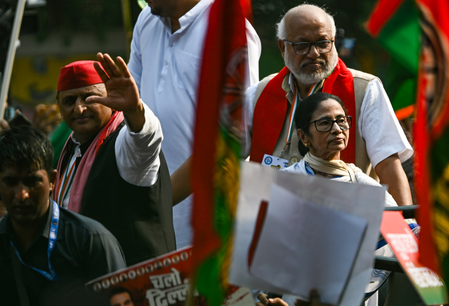
It has been further fanned, apparently, after an unverified photograph portraying camaraderie at Sunday’s INDIA bloc rally in New Delhi, where Baby is seen whispering into Mamata’s ear as the latter listens attentively, with a smile on her face.
The depiction would have been unbelievable, and also abhorred, even in the recent past, since Mamata’s lone political goal has been breaching West Bengal’s Red bastion that she achieved in 2011, about 13 years after she broke out of the Congress party, questioning its political intention.
At the heart of the controversy is the question of whether the Left can effectively fight the BJP while maintaining an uncompromising political struggle against Mamata’s Trinamool Congress, especially in West Bengal.
One school of thought among communists is that in order to contest the “larger enemy”, i.e., the BJP, Left parties must mend fences with the perceived “enemy’s enemy” even if they are regional adversaries.
Those advocating this theory point to the fact that the consolidation of the Left happened only after the top decision-making body of the CPI (M) vetted a proposal to ride on support to the Congress party in its fight against “communal forces”.
They further link the withdrawal of support to the Congress-led United Progressive Alliance (UPA) as the beginning of an erosion in popular mandate. There is a strong resistance to this theory, who cite the failure of their alliance with the Congress in West Bengal in challenging Mamata during her heydays.
Another factor is the Left coalition’s direct contest against a Congress-led alliance in Kerala. Dialogues on the ground and media reports mention a section of the party seeing the evolving political line as “Baby steps” away from the strategic framework associated with veteran Marxist leader and former General Secretary Prakash Karat.
For years, the Bengal Left maintained that the BJP and the Trinamool Congress represented two sides of the same coin. Left leaders once argued that any political understanding with Mamata Banerjee would weaken their independent space and confuse their cadre base, particularly in a state where the party alleged atrocities on its supporters by her regime.
Observers view that since becoming CPI (M) chief, Baby has placed considerable emphasis on strengthening “anti-BJP unity”, where his interactions with Mamata within the framework of the INDIA bloc have been noticed as “cordial”.
While the BJP remains the dominant force in Indian politics, the CPI (M)’s parliamentary presence is a fraction of what it once was. In such circumstances, many within the party believe that Opposition unity has become a strategic necessity rather than a tactical option. But for party hardliners, the images and messaging risk sending a signal that the CPI (M) is softening its opposition to the Trinamool.
In West Bengal, Left workers who faced Trinamool on the ground during Mamata’s tenure often view excessive proximity with suspicion. They fear that blurred political messaging could further erode the Left’s independent support base and reinforce perceptions that it has accepted a secondary role in state politics.
–IANS
jb/snj/skp