



Quetta, July 5 (IANS) The government of Pakistan’s Balochistan is mulling legal action against the Sindh government over what it termed the unfair distribution of canal water after the latter’s Chief Minister and other authorities have failed to ensure that their province received its approved share, local media reported on Sunday.
The continued reductions in water supplied by Sindh despite an improvement in river flows have resulted in a shortage of canal water in Balochistan, Pakistan’s The Express Tribune reported, citing provincial officials.
Pat Feeder Canal Superintending Engineer Mudassar Khoso said that the Indus River System Authority (IRSA) had reported better water availability; however, the Sindh Irrigation Department was still providing 46 per cent less water than its allocated share to Balochistan. He said Balochistan was presently getting just 0.365 million acre-feet (MAF) of water against its allocated share of 0.678 MAF, resulting in a shortfall of 0.310 MAF.
Balochistan’s Irrigation Minister Mir Muhammad Sadiq Umrani said the continued reduction in the canal water share by Sindh was making the water issue serious in the province. He said that the issue has been raised with Pakistan’s Federal Water Resources Minister, the Sindh Irrigation Minister, the Sindh Irrigation Secretary, and the IRSA Chairman through meetings and written communications, urging them to stop reductions in water supply to Balochistan.
Umrani said Balochistan Chief Minister Mir Sarfraz Bugti had consulted his Sindh counterpart Syed Murad Ali Shah, who assured him that no reductions in water supply to the province would be made. However, he said that officials of the Sindh Irrigation Department continued to reduce water supplies to Balochistan, The Express Tribune reported.
He said that the IRSA Chairman had also written a letter to the Sindh government, stating that Punjab was not behind the deduction and it was Sindh that was making the reductions. Umrani said that Balochistan has not received its allocated share of water despite using all means, terming it unfair treatment and announced that the provincial government was considering a legal route against the Sindh government. The minister said that he would meet Balochistan CM and seek his approval for legal action against the Sindh government.
A report in February highlighted that a major water crisis was unfolding in Balochistan, along with a demographic explosion that threatens to overwhelm the fragile ecology of the province.
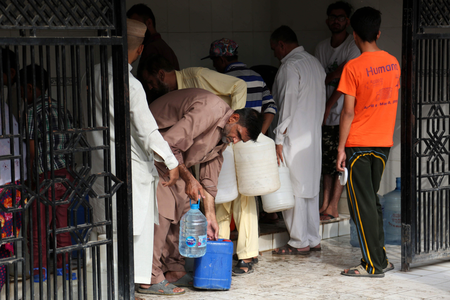
“Every morning in Quetta, before the sun clears the jagged peaks of the Sulaiman Mountains, a ritual of anxiety begins. It starts with the hollow, metallic clink of a dry tap. For thousands of households, this sound is the starting gun for a daily race for survival. With it echo the neighbourhoods with one question: ‘Will water come today?'” a report in the Express Tribune magazine stated.
“In the sprawling neighbourhoods of the provincial capital, families ration every drop, calculating whether a litre of water should be used for cooking a meal or washing a child’s face. What was once a seasonal inconvenience has hardened into a defining feature of life in Balochistan. This quiet crisis is unfolding alongside a demographic explosion that threatens to overwhelm the province’s fragile ecology,” it added.
According to Population Management and Communication Team (PMCT) Director Abdul Sattar Shahwani, the population of Balochistan has increased to 14.89 million, up from 12.34 million in 2017, showcasing an average annual growth rate of 3.2 per cent. Official projections suggest that Balochistan will have a population of 18.57 million people by 2030, and the figure could be over 35 million by 2050.
“We are adding millions of people to a landscape that is physically losing its ability to support life,” the report quoted a local urban planning consultant as saying.
“If the population doubles while the water table halves, the math simply doesn’t work. We are heading toward an impossibility.”
For decades, Balochistan survived on its groundwater; however, the account is now overdrawn. The World Bank stated that 95 per cent of Balochistan’s farmland depends on groundwater extraction. Only five per cent of Balochistan is linked to the Indus Basin’s canal system. This over-dependence has turned a lifeline into a liability.
–IANS
akl/vd