




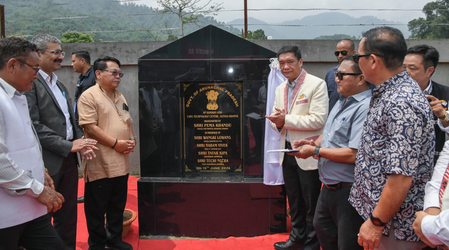
Itanagar, June 15 (IANS) Arunachal Pradesh Chief Minister Pema Khandu on Monday described bamboo as an inseparable part of the state’s tribal life and culture, asserting that the resource has the potential to drive sustainable economic growth, entrepreneurship, employment generation and environmental conservation.
Inaugurating the Arunachal Pradesh Bamboo & Cane Technology Centre at Gungu near Itanagar, Khandu said bamboo has been deeply woven into the social, cultural and economic fabric of Arunachal Pradesh for generations and remains integral to the lives of all the state’s 26 major tribes.
“Bamboo is not a new subject for us. Long before modern institutions came into existence, bamboo played a central role in the lives of our tribal communities. Across all 26 major tribes of Arunachal Pradesh, bamboo remains an inseparable part of daily life, culture and tradition,” he said.
The Chief Minister said the newly inaugurated centre would play a key role in transforming the state’s vast bamboo resources into value-added products while creating livelihood opportunities for local youth, artisans, self-help groups and entrepreneurs.
Appreciating the efforts of the Arunachal Pradesh Bamboo Resources and Development Agency (APBRDA), the Forest Department, and other stakeholders, Khandu said the facility would serve as a hub for innovation, skill development, value addition, and the commercialisation of bamboo-based products.
Referring to technological advancements in bamboo processing, he noted that bamboo is no longer confined to traditional handicrafts and household items but has emerged as a versatile industrial resource with applications in furniture, construction materials, textiles, biofuel and even aviation fuel.
Khandu credited Prime Minister Narendra Modi for introducing transformative reforms in the bamboo sector by removing it from the category of trees under forest regulations and recognising it as grass, thereby simplifying procedures for cultivation, transportation, and commercial utilisation.
“Today, bamboo is rightly called ‘Green Gold’. Arunachal Pradesh possesses the second-largest bamboo stock in the country and more than 60 bamboo species. We must harness this immense resource professionally and scientifically for the benefit of our people,” he said.
Calling upon local youth, particularly from the Gungu and Sangdupota areas, to utilise the training facilities available at the centre, Khandu urged them to develop entrepreneurial ventures based on bamboo products.
He also appealed to Panchayati Raj representatives, community leaders, and other stakeholders to motivate young people to acquire skills and benefit from government schemes that promote entrepreneurship and self-employment.
Highlighting opportunities under the Prime Minister’s UNNATI Scheme and various MSME programmes, the Chief Minister said bamboo-based enterprises could access national and international markets through e-commerce platforms.
Khandu also advocated adopting bamboo-based prefabricated housing technology across Arunachal Pradesh and the Himalayan region. He observed that bamboo structures are cost-effective, lightweight, environmentally sustainable and better suited to seismic zones than many conventional construction methods.
“Arunachal Pradesh falls in a high seismic zone. Bamboo-based prefabricated structures can provide sustainable and aesthetically appealing alternatives while preserving our traditional architectural heritage,” he said.
Emphasising innovation in infrastructure development, the Chief Minister called for greater research into region-specific technologies for roads, housing and public infrastructure suited to the climatic and geographical conditions of the Northeastern and Himalayan states.
He further highlighted bamboo’s industrial potential in sectors such as textiles, furniture, handicrafts, biofuel production, ethanol manufacturing, and sustainable construction materials. Referring to countries such as Vietnam, where bamboo contributes significantly to the economy, Khandu said Arunachal Pradesh must adopt a professional, market-oriented approach to developing the sector.
He stressed the need for a comprehensive bamboo policy and a scientific roadmap covering bamboo cultivation, regeneration, processing, marketing and industrial utilisation.
The Chief Minister directed APBRDA experts, scientists, and officials to prepare a long-term vision document for bamboo development across the state and to ensure the scientific management of bamboo flowering and regeneration cycles to maintain uninterrupted raw material availability.
Khandu also advocated establishing similar bamboo technology and training centres in other parts of Arunachal Pradesh, particularly in the eastern and western regions, to expand access to training and livelihood opportunities.
Underscoring the importance of skill development, he said creating a skilled local workforce would reduce dependence on outside labour and generate employment opportunities for the state’s youth.
Citing a recent example, Khandu said a group of Arunachali youth trained under government-supported skill development programmes successfully completed an electrical and plumbing project worth Rs 10 lakh, compared to an outside agency’s quotation of Rs 18 lakh.
“This demonstrates the importance of skilling and self-reliance. Arunachal Pradesh has immense employment opportunities. We must equip our youth with the necessary skills and reduce dependence on external manpower,” he said.
Highlighting the large-scale investments flowing into the state through hydropower projects, the Chief Minister said thousands of skilled workers would be required in the coming years, making skill development a critical priority.
Khandu further noted that Sangdupota and adjoining areas are emerging as an important growth corridor for the Capital Region.
He pointed out that several educational and institutional establishments, including the National Institute of Technology (NIT), the Film and Television Institute, the Law College, and the Women’s College, are already located in the area, and that future expansion of the Capital Region is expected in this direction.
Responding to local demands, the Chief Minister assured support for strengthening water supply infrastructure and constructing a bridge to improve connectivity to the Bamboo & Cane Technology Centre.
He directed the concerned departments to prepare Detailed Project Reports (DPRs) for the proposed projects for consideration by the state government.
–IANS
sc/dan