



Dhaka, July 24 (IANS) Bangladesh has projected itself as a nation founded on the principles of linguistic identity, secularism and democratic pluralism. Born out of the Liberation War of 1971, the country’s Constitution envisioned equal rights for all irrespective of religion. Yet, the reality is much more complex.
The suspension of the proposed 82-foot Lord Ram statue at a temple complex in Palashbari, Gaibandha, has renewed concerns among Bangladesh’s Hindu community regarding the security of their religious and cultural spaces. The temple, being constructed alongside the historic Sri Radha Govinda Temple and Kali Temple, was reportedly nearly 80 per cent complete before authorities halted the project. It would have acted as a booster for the Hindu community after what happened with the 2021 Durga Puja Pandal and all that was lost during Muhammad Yunus’ tenure who led the interim government after former Prime Minister Sheikh Hasina was forced to leave the country.
The issue escalated when Haridas Chandra Tarani Das was arrested and sent to one-year jail based on false allegations of money laundering. According to ‘JusticeMakers Bangladesh in France’ (JMBF), the suspension was a result of pressure applied by the Islamist groups, threats of communal unrest by Muslims, and concerns over minority security.
The suspension of the Ram statue was not a dispute over a religious monument, it exposed the shrinking political space for Bangladeshi Hindus. At the time of Partition in 1947, Hindus constituted more than 22.8 per cent of the population which has lowered down to 7.3 per cent at present.
The political transition after Sheikh Hasina’s ouster in August 2024 led another blow to the Hindu community. Hasina had tried to bridge the gap by repeatedly affirming a better future for the Hindus. The Bangladesh Hindu Buddhist Christian Unity Council reported over 3200 incidents of violence against Hindus, 200–300 Hindu homes and businesses and 15–20 temples being attacked or vandalised across the country between August 2024 and June 2026. The latest incident was the demolition of a 500-year-old temple in Noakhali.
Amnesty International had earlier called on the interim government to conduct “swift, thorough, impartial and independent investigations” into crimes against Hindu, Ahmadi and other minority communities. It had urged to prosecute those responsible through fair trials, and ensure justice, reparations and guarantees of non-recurrence. Human Rights Watch (HRW) also similarly asked the authorities to protect minorities and uphold human rights following the violence.
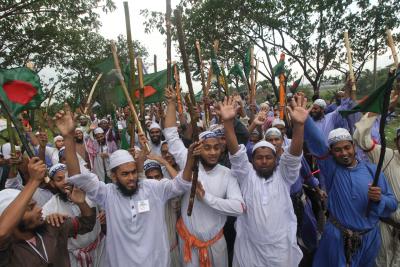
The surge in communal violence has coincided with the renewed political visibility of Islamist organisations, particularly Jamaat-e-Islami – a party which has contributed to the oppression and has also backed imposing the Islamic principles in public life. Its repeated protests for the implementation of the July Charter, which will completely change the Constitution, has only intensified the differentiation that minority groups, especially Hindus, will face after its implementation.
Yunus and Jamaat-e-Islami Ameer Shafiqur Rahman, widely perceived as a Pakistani agent, regularly held political consultations after Hasina had left. A high surge of religious conversion – either by marriage or forcefully – was also witnessed during the tenure of the interim government led by Yunus.
Jamaat was steadily rehabilitated within Bangladesh’s political mainstream despite its historical alignment with Pakistan and its contested political legacy. Jamaat being the advocator of Quran and Sunnah stressed that they are the primary basis of legislation, and no law by Parliament can contradict Islamic injunctions. They have repeatedly demanded for constitutional reforms for strengthening Allah’s role in governance and have opposed secularism.
Jamaat leaders have repeatedly emphasized strengthening relations with Pakistan, referring to it as a “brotherly Muslim country” and advocating closer cooperation in trade, education, diplomacy and cultural exchanges with Islamabad. Senior Jamaat-e-Islami leaders, including Ameer Shafiqur Rahman and Nayeb-e-Ameer Syed Abdullah Mohammad Taher, have argued that historical grievances should not impede present-day relations between Bangladesh and Pakistan. They have repeatedly asserted that Bangladesh’s constitutional framework should explicitly reflect the country’s Muslim-majority identity by incorporating greater adherence to Sharia-based principles in legislation and public policy.
The fears expressed today are rooted not only in political rhetoric but also in a series of violent incidents that unfolded during and after the July 2024 uprising. Sub-Inspector Santosh Chowdhury, a Hindu police officer was lynched by a mob during the attack on Baniachong Police Station in Habiganj in August 2024 when the protesters burnt the whole police station. In May 2025, Goddess Kali temple was burnt down in an arson attack in the Hindu-majority Ghuna-Sadarpara Area of Manikganj.
The debate extends beyond political symbolism. This perceived inability to decisively curb communal violence has strengthened the belief among sections of the Hindu minority that extremist elements are operating with greater confidence than before. The issue is no longer viewed solely through the lens of electoral politics.
The continuous suspension of all religious activities of Hindus, recurring attacks on temples and repeated communal tensions collectively reinforce a belief among many members of the community that minority concerns are increasingly overshadowed by larger political calculations.
Regardless of where responsibility ultimately lies, the confidence of Bangladesh’s Hindu community has weakened considerably. The larger question extends far beyond foreign policy. It concerns the very character of the Bangladeshi state itself. Can Bangladesh preserve the secular aspirations that shaped its birth while accommodating a stronger role for religious politics? Can democratic institutions continue to guarantee equal citizenship irrespective of faith? Most importantly, can minorities regain confidence that the Constitution protects them not only on paper but also in everyday life?
History demonstrates that democracies are rarely transformed overnight. Instead, change often unfolds gradually — through shifts in political discourse, institutional decisions, demographic pressures and societal compromises. It is often within these incremental developments that minority communities become the earliest indicators of a nation’s democratic health.
The future of Bangladesh will therefore not be judged solely by elections or economic growth but by the reemergence of Islamists and what they describe as a growing culture of impunity. It will also be measured by whether a Hindu family feels secure celebrating Durga Puja, whether an ancient temple stands without fear of destruction, whether religious identity determines access to justice, and whether every citizen — regardless of faith — can exercise constitutional rights without intimidation.
–IANS
scor/as