




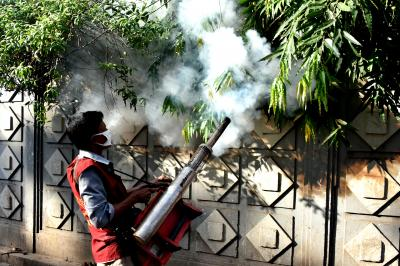
Dhaka, Aug 8 (IANS) As Bangladesh grapples with a worsening dengue outbreak, at least 59 people have died from the disease, while 17,880 cases have been reported so far this year, local media reported citing data from the country’s Directorate General of Health Services (DGHS).
According to DGHS data, Dhaka division has emerged as Bangladesh’s worst affected region, recording 6,871 cases this year, including 4,404 infections in Dhaka city alone.
With 3,647 cases, Barishal division accounted for the second-highest number of infections, followed by Chattogram with 3,082 and Khulna with 2,272.
Additionally, Dhaka division topped the list for dengue fatalities, with 26 deaths, 25 of which were reported in Dhaka city. Khulna recorded the second-highest death toll at 12, followed by Chattogram and Mymensingh with seven and six deaths, respectively, Bangladesh’s leading newspaper The Daily Star reported.
Dengue, a mosquito-borne viral disease, has emerged as a serious public health concern in Bangladesh. It is primarily transmitted by the Aedes aegypti mosquito.
GM Saifur Rahman, Associate Professor in the Department of Zoology at the National University of Bangladesh, said that the latest figure reflects Dhaka’s combination of high population density, persistent Aedes mosquito breeding, and inadequate vector control measures.
The combination of high population density, warm climate and abundant breeding grounds reportedly provides ideal conditions for both Aedes mosquitoes and the dengue virus to circulate year-round, turning the Dhaka division into a major dengue hotspot.
“Just a few days ago, while supervising an examination at Central Metropolitan Women’s College, I found Aedes mosquito larvae in a small container of water. Such breeding sites are common across the city, indicating that Aedes mosquitoes are reproducing continuously in residential areas,” The Daily Star quoted Saifur as saying.
Stressing that the mosquito control measures have been largely reactive rather than preventive, he further said, “The most effective strategy would be to intensify mosquito control during periods when dengue transmission is relatively low. At that time, breeding sites are fewer, and interventions can be more effective. Instead, mosquito control usually intensifies only after the dengue season begins, by which time infections are already increasing rapidly.”
According to Saifur, Bangladesh’s failure to establish an effective, centralised mosquito control mechanism has worsened the country’s dengue situation. He called for the formation of a national mosquito control authority staffed with expert entomologists to coordinate, monitor and oversee vector control measures nationwide.
“Until we establish a coordinated national control system, dengue cases are likely to continue rising,” he warned.
Kabirul Bashar, Professor of the Zoology Department at Jahangirnagar University, warned that dengue infections are expected to surge through August and could continue their upward trajectory into September.
“The peak may not occur in August. It’s possible that this year’s peak will come in September. What we can say is that the upward trend is likely to continue through August and into September,” he said.
–IANS
scor/rs