




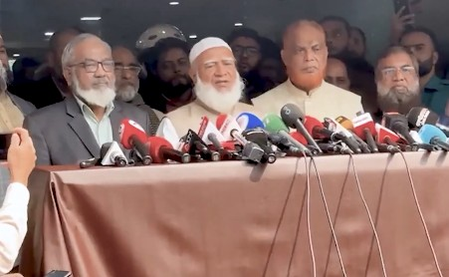
Dhaka, Feb 3 (IANS) For Bangladesh to develop as a democratic state, citizens must question whether a radical political party like Jamaat-e-Islami, with its regressive stance on women, has the right to remain registered and function within the country’s existing constitutional and legal framework, a report questioned on Tuesday. Until these fundamental questions are addressed, it added, entrusting such a party the responsibility of governing the state would be irresponsible.
According to a report in Bangladesh’s leading daily Prothom Alo, the Proclamation of Independence, the commitment to human dignity embedded in the preamble of the country’s Constitution, and Article 28 of the Constitution prohibit any political party from discriminating on the grounds of religion, race, gender, or socio-economic status. Yet it is evident that Jamaat, through both its constitution and actions, discriminates against Muslim women and all non-Muslims alike, effectively treating them as second-class citizens.
“Evidence of Jamaat’s negative attitude towards women is also found in many of the Ameer’s recent statements. His declaration that women’s working hours should be limited to five hours, and his remarks in that context, effectively demonstrate a mindset intent on confining women to the home. At one meeting, he stated, ‘The employer will pay for five hours, and the government will pay for three hours. Those who work at home will be honoured as ‘ratnagarbha’ mothers. If women want to work eight hours, they will be honoured’,” the report detailed.
“More recently, at a gathering of young people, the Jamaat Ameer made sharply sarcastic and derogatory remarks about women who work outside the home. At that meeting, he first asked how many attendees were unmarried, then offered advice on marriage: ‘From now on, resolve to bring home a queen, not a labourer. Whomever you bring, give her the status of a queen, the status of a rose’,” it added.
The report stressed that while individuals may hold personal views about the role of women within the family, society, or the workplace, it questioned whether a political party functioning within a state can include provisions in its constitution that directly contradict the national constitution.
Surprisingly, female members within Jamaat have stated that they accept the party’s position on women’s leadership.
“Almighty Allah has said in the Holy Quran that men are the guardians of women. We accepted this when we embraced faith. Therefore, women attaining top leadership positions is not important; what matters is whether women’s rights are being realised,” Prothom Alo quoted Nurunnisa Siddika, Secretary General of Jamaat’s women’s wing, as saying while responding to a question of women’s leadership.
With the Bangladesh national election just nine days away, critics warn that Jamaat’s persistent misogynistic remarks and its decision to field no women candidates in the upcoming polls risk pushing the nation towards a regressive political path.
–IANS
scor/as