




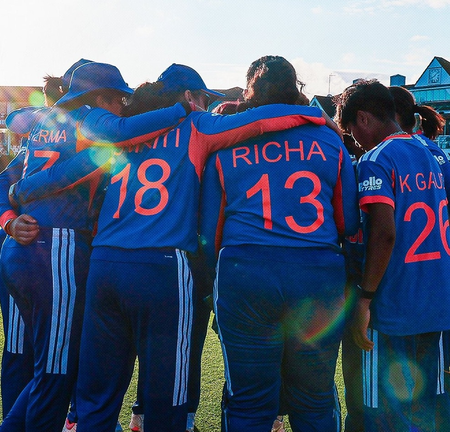
New Delhi, June 8 (IANS) India will enter the tenth edition of the Women’s T20 World Cup in England and Wales on the back of winning the 50-over World Cup on home soil last year. The Harmanpreet Kaur-led side has a batting lineup capable of frightening any opponent, yet the bowling attack is still relatively inexperienced to excel in English conditions.
India’s best finish in the Women’s T20 World Cup came in 2020 when they became runners-up after losing to Australia in the final at Melbourne Cricket Ground. With the side set to open their Group 1 campaign against Pakistan on June 14 and followed by taking on Bangladesh, Netherlands, South Africa and Australia, IANS takes a look at the Indian team through an in-depth SWOT analysis.
Strengths: The batting is where India genuinely stands apart from other 11 teams. Since the last Women’s T20 World Cup in 2024, their top order possesses the second-highest team average in the world (30.1) and run rate (8.8), which is behind only six-time winners Australia.
At the top, Smriti Mandhana and Shafali Verma have been nothing short of devastating. Their opening partnership has yielded 762 runs in that period, with a strike rate of 150, more than any other pair in women’s T20Is.
Smriti’s record in England specifically warrants attention. Among batters with 500 or more runs in women’s T20Is in England, nobody averages higher than her 38.3. Despite her making 40 runs in the recent 2-1 T20I series loss in England, India will count on Smriti to get big runs at the top in the World Cup.
Shafali, meanwhile, brings something different – raw power coupled with immense maturity. Her strike rate of 157 during the powerplay since the 2024 World Cup is the highest among any batter who has faced a significant volume of balls, and she has somehow been even more destructive in the middle overs, striking at 164.
She has hit 16 sixes in this period, joint-second in the world alongside Smriti, Sophie Devine and Sobhana Mostary. One will hope that Shafali will finally hit her first T20 World Cup fifty in England, as her explosive power-game separates her from a lot of batters in T20Is.
The spin bowling department is also another strength point of India, especially if hot conditions are on offer on match days. Post the 2024 edition, the Indian spin bowling unit has the second-best balls per wicket rate (17.9) after Australia, while picking 84 wickets in 24 innings at an economy rate of 7.6.
Sree Charani, who debuted in T20is in England last year and took ten wickets in that series to win Player of the Series award, will hold the key again alongside Shreyanka Patil and Radha Yadav. Deepti Sharma, the all-time leading wicket-taker in women’s T20Is with 161 scalps, provides the experience that holds the Indian team together despite a slight recent mixed time in the format.
Weaknesses: The pace bowling department remains a persistent source of anxiety, especially with no Amanjot Kaur and Kashvee Gautam due to back and knee injuries respectively. With Renuka Singh Thakur not featuring in India’s 2-1 series loss to England due to unknown reasons, it has meant that the side are well short of depth in fast bowling pool.
Moreover, not all bowlers in the Indian team have considerable experience of bowling in English conditions, which means there’s inexperience aplenty and that’s something which opposition batters will look to exploit. In the powerplay, when conditions in England may offer the most help, India have been the most expensive attack in – conceding at eight runs per over, and they take a wicket only once every 28 balls – again the worst figure among the top teams.
For a side that relies heavily on spinners to do the choking and wicket-taking job, the pacers giving away runs could prove to be costly. There is also the matter of India not settling its middle order – Yastika Bhatia did well on return to the T20I team after two years at number three, a place held by Jemimah Rodrigues for a long time. But her tendency to suffer a slowdown after power-play means the pressure comes more on batters coming after her to do the bulk of the scoring.
The point of concern for India is also their finishing department – Richa Ghosh hasn’t fired yet while Bharti Fulmali, who was brought into the Indian team for the second finisher role, has not got a consistent run and when she has come in, hasn’t looked in prime touch.
Opportunities: A year ago, India lifted the 50-over World Cup on home soil and sent the nation into the joy of breaking the drought of a senior women’s cricket silverware. Now, going all the way to the T20 World Cup title will help India become the third side to clinch back-to-back silverwares after Australia and England.
Momentum has been on India’s side until at least April’s 4-1 defeat to South Africa and 2-1 loss to England. But India can take heart from their ability to switch on and perform well when it matters the most. Since the 2024 Women’s World Cup, India have a win percentage of nearly 62 percent – something which suggests a team moving in the right direction, even if the last few weeks have introduced doubts in the mind of its ardent supporters.
The WPL has handed Harmanpreet two players who could change the complexion of close matches. Bharti is the power-hitter India’s lower order has been eyeing on. Her role is straightforward – to go after bowling alongside Richa and give the innings a good finishing flourish.
Meanwhile, Nandni Sharma arrives with even more fanfare. The Chandigarh-based pacer is the joint-leading wicket-taker in this year’s WPL with 17 scalps from ten outings, she walked into her T20I debut against England last month and took 3-34. For a bowling attack searching for variety, Nandni is a timely arrival.
Threats: The mixed recent form of India has meant that there’s a feeling of the script from 2024 edition possibly repeating in 2026. In the UAE in 2024, India entered the competition with high expectations but unravelled after a heavy opening defeat to New Zealand in Dubai.
The loss to eventual T20 World Cup winners triggered a slide that ended in a group‑stage exit for India, as their unresolved selection issues, injuries and deeper tactical flaws led to their campaign ending on a disassociating note.
For India to enter the semi-finals, it has to upstage South Africa and Australia in Group 1. The Proteas have been dominant, while Australia, entering without the pressure of a silverware defence, are dangerous to deal with in major competitions. India have been here before – good enough to go deep, unable to go all the way. Whether that is enough remains the only question that matters.
–IANS
nr/bc