




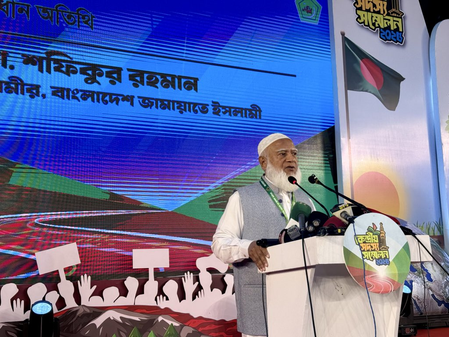
Dhaka, Feb 1 (IANS) Bangladesh Jamaat-e-Islami (JeI) has finalised Krishna Nandi, president of the party’s Hindu committee in Dumuria Upazila, as its candidate for the Khulna-1 (Dakop–Batiaghata) constituency, apparently showcasing that people of all faiths are included in the party.
However, Jamaat-e-Islami’s attempt to shed its exclusive tag and portray itself as an inclusive organisation falls short of genuine inclusivity without drastic amendments to its constitution.
In 2008, Jamaat-e-Islami amended its constitution to allow non-Muslims to join the party to retain its registration under amended provisions of the Representation of the People Order (RPO), under which party constitutions need to conform to Bangladesh’s constitution and ban religious discrimination, according to a report in Bangladesh-based The Business Standard.
However, the Jamaat-e-Islami constitution’s preamble, fundamental faith and guiding principles suggest that non-Muslims can’t join the party.
“Without drastic amendments to its constitution, the party’s attempt to shed its exclusive tag and present itself as an inclusive organisation like a political party, which is meant to be accessible to all citizens, falls short of genuine inclusivity,” Shamim A Zahedy wrote in a report in The Business Standard.
According to the constitution of the party, any citizen or any non-Muslim of Bangladesh can join Jamaat-e-Islami. However, it still does not give full membership to non-Muslim people. Section 11 of the Jamaat constitution reads, “Any non-Muslim citizen of Bangladesh can be an associate member of Jamaat-e-Islami if he/she expresses solidarity with the political and economic programmes of Jamaat-e-Islami.” So, Krishna Nandi and other Hindus who have recently joined the party are not full members of the Jamaat-e-Islami.
A report in The Business Standard stated, “The party’s fundamental faith section explicitly defines its ideology in strictly Islamic terms, asserting belief in Allah and the prophethood of Muhammad as central to its identity. The preamble states that there is no Lord except Allah, that all natural laws are controlled, dictated, and facilitated solely by Him, and that Prophet Muhammad (Peace be upon him), the prophet for the whole world, is the last and final prophet.
“It further declares that the Quran, sent by Allah, and the life of Prophet Muhammad (Peace be upon him) serve as the only model and ideology that human beings can follow. Such requirements are nearly impossible for non-Muslims to adhere to,” it added.
For full membership in Jamaat-e-Islami, a person needs to follow Islamic practice. Under Section 7, the constitution of the party stated that a person may become a member only if he or she conducts all Farz (mandatory Islamic duties) and recommended activities, avoids income and behaviour contrary to submission to Allah and does not engage with organisations whose policies are opposed to Islam. The duties and responsibilities of a party member are linked to Islamic practices as mentioned in Section 9 of the Jamaat-e-Islami constitution.
“A member must be aware of the ‘boundaries of Shariah as determined by Allah; shape his or her belief, faith, thought, outlook, and activities in accordance with the Quran and the Sunnah; avoid all forms of affection and close association with religiously disobedient individuals and those who have deviated from Allah except for the cause of Islam; establish firm relationships with believers; and demonstrate adherence to the fundamental principles of Islam,’ Shamim A Zahedy wrote in a report in The Business Standard
“These requirements are religious and practice-based, not merely ideological, effectively making full membership inaccessible to non-Muslims and meaning that only Muslims can advance within the party’s structures and policymaking. These contradictions lay bare Jamaat-e-Islami’s weak attempt to appear inclusive, exposing the party’s indecision and political opportunism,” he added.
–IANS
akl/dan