



Kolkata, June 23 (IANS) The trend of budgetary allocations for different West Bengal government departments for the ongoing financial year of 2026-27 clearly demonstrates the new Bharatiya Janata Party (BJP)-ruled state government’s commitment to industrial development in the state through industry-driven infrastructure and social development.
The departments which have witnessed the maximum increase in the budgetary allocations for the financial year under review have the scope for undertaking both social and infrastructure development, which will ultimately help the state government create an ideal ambience and infrastructure to attract big-ticket investment in the state.
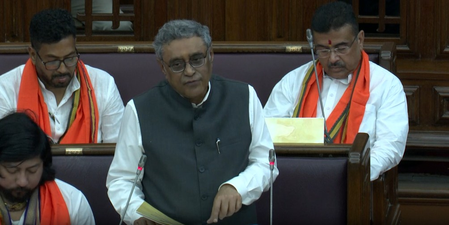
The two state departments focusing on the area-wise or zone-wise development namely North Bengal Development Department and state Western Regional Development Department, which is officially known as the Paschimanchal Unnayan Affairs (PUA) department have witnessed the maximum increase budgetary allocation for 2026-27 in the state budget for the fiscal under review which was tabled at the floor of the state assembly by the new state finance minister, Swapan Dasgupta, a journalist-turned-politician.
While the budgetary allocation for the North Bengal Development department had almost been doubled to Rs 1821.52 crore from the previous allocation of just Rs 920.13 crore, the same for the PUA had been increased to Rs 1,610.85 crore from the previous allocation of just Rs 810.04 crore.
Economists feel that, considering the nature of functioning of these two departments, having the scope for both social and industry-driven infrastructure development, the new finance minister has virtually killed two birds with one stone by going for a massive increase in budgetary allocation.
In the case of North Bengal, while there is a massive scope for social development, especially for the huge tribal population in the region, which is also blessed with hills and dense forest, it has immense potential for industrial development, especially in the triple-T (Tea, Tourism and Timber) and medicinal herbs sector.
Similarly, in the case of PUA, the targeted districts are Bankura, Birbhum, Jhargram, Paschim Bardhaman, Paschim Medinipur, West Burdwan, and Purulia, two of which have dual avenues for both social and industry-driven infrastructure development
Besides a huge tribal population in the majority of these districts, the region is also blessed with rich varieties of nature. On one hand, the dense forests and red soil region provide immense scope for the development of nature tourism, on the other, the belt is enriched with coal and other mineral reserves, thus providing the scope for immense industrial development, with West Burdwan being traditionally identified as the key industrial pocket in the state.
Hence, feel economists, the almost doubling of the budgetary allocation for these two departments is a highly calculated move.
Political observers, however, feel that the move’s motive is not just prompted by economic realities but also backed by political compulsions. According to them, in the recently concluded West Bengal assembly elections, the BJP’s performance was the best in these pockets.
“There are many districts which come under the purview of these two departments, where the BJP candidates swept from all the assembly constituencies, reducing Trinamool Congress to duck there. So, in a way, the doubled budgetary allocations for these two departments are in a way also a reward for the massive support,” said a city-based political observer.
Another department, where the budgetary allocation had been more than doubled, is that of the state commerce & industry department, where the allocation for 2026-27 had been increased to Rs 3266.59 crore from the previous allocation of just Rs 1,483.97 crore.
During his budget speech on Monday, the state finance department had announced a policy decision to ensure “ease of doing business’ in West Bengal, where, henceforth, any investment proposal of Rs 100 crore and above will be provided all necessary clearances through a single-window system of the state government, thus easing the pain of the investors from approaching different departments for different clearances.
The new state government’s focus for encouraging big-ticket investment in the services sector, especially in the Information Technology and Information Technology- enabled Services (IT&ITeS), is reflected in the budgetary allocation of Rs 506.18 crore for the Information Technology and Electronics Department for 2026-27, a figure which is over double the previous allocation of Rs 217.16 crore.
–IANS
src/snj/skp