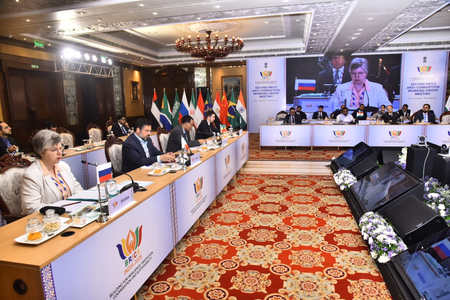
Hyderabad, Aug 5 (IANS) The second meeting of the BRICS Anti-Corruption Working Group and the BRICS Expert Network on Asset Recovery, which concluded here on Wednesday, reached an in-principle agreement on the proposed BRICS Network of Law-Enforcement Practitioners for Enhancing International Cooperation on Fugitive Offenders Sought for Corruption and Supporting Extradition.
During the two-day meeting, BRICS members made significant progress on the Indian Presidency’s proposal for a BRICS network.
Members held constructive discussions on the objectives, scope and operational modalities of the proposed network and reached an in-principle agreement on the initiative and decided to continue deliberations on establishing a dedicated practitioner-level platform, said an official release.
The initiative is expected to facilitate informal cooperation, support the tracing of fugitive offenders and complement existing formal mechanisms for extradition and international cooperation.
Members also welcomed the BRICS Repository on Informal Cooperation for Tracing Fugitive Offenders Sought for Corruption and Supporting Extradition. This would serve as a practical, practitioner-oriented resource bringing together information on national practices and existing channels of informal cooperation.
The second meeting of the BRICS Expert Network on Asset Recovery made substantive progress on practical deliverables aimed at strengthening direct cooperation among competent authorities. Members reached consensus on the standardised formats to facilitate timely practitioner-level information exchange during the preliminary stages of investigations while complementing formal mutual legal assistance mechanisms.
The Centre’s Department of Personnel and Training (DoPT) successfully hosted the meetings in line with the theme of India’s BRICS Presidency, “Building for Resilience, Innovation, Cooperation and Sustainability”.
Senior policymakers, experts, practitioners and representatives of anti-corruption, financial intelligence and law-enforcement agencies from BRICS member countries shared their views on various anti-corruption-related matters.
The meeting was inaugurated by Rachna Shah, the Secretary, Department of Personnel and Training, who welcomed the delegations and highlighted India’s policy of zero tolerance against corruption.
She emphasised that integrity is fundamental to good governance, sustainable development and public trust, and underscored the importance of strong institutions, technology-driven governance, transparency, accountability and sustained international cooperation.
The Secretary observed that the BRICS Anti-Corruption Working Group was increasingly evolving from a platform for developing common understanding into a platform for practical action. She emphasised that effective international cooperation requires timely exchange of information, early engagement among competent authorities and trusted practitioner-level channels capable of complementing formal mutual legal assistance and extradition mechanisms.
–IANS
ms/vd