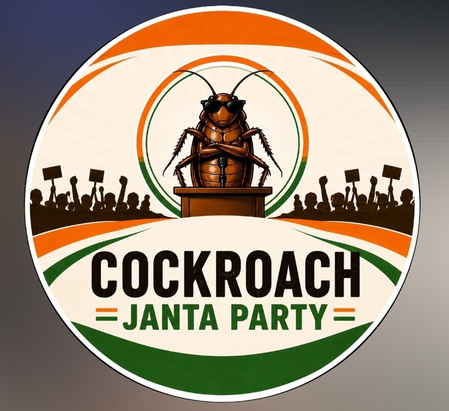
 Every political era coins its metaphors, but few arrive with such strange provenance. The term “cockroach party” now slung across Indian social media did not emerge from a domestic political mind. It began as a joke—a sitting US chief justice’s casual observation about resilience, twisted by anonymous wit into a crude biological analogy. Then the meme factories took over. Today, the label has stuck not because of its foreign origin, but because of its unnerving accuracy. Watching a particular Indian party survive wave after wave of electoral annihilation, legal scrutiny, and internal collapse raises a sober question: is this creature a pest to be exterminated, or a necessary scavenger that exposes the system’s hidden rot?
The original remark, stripped of context, was never meant to describe any Indian formation. But social media cares little for fidelity. A screenshot, a sarcastic caption, a thousand retweets—and the metaphor hardened into political currency. What began as a transatlantic joke now shapes how millions of Indians talk about opposition survival. That in itself is a lesson. In today’s democracy, a phrase’s power no longer lies with its author, but with its audience.
Now to the party in question. Like the insect, it hides from harsh light. It reproduces swiftly when conditions turn favourable. And crucially, it develops resistance to poisons over time. After two consecutive general election defeats that reduced it to fewer than a hundred seats, every obituary was written. Yet within eighteen months, it has clawed back three major state assemblies, rebuilt its district-level cadre, and discovered a new political vocabulary that has visibly rattled the ruling establishment.
How has this evolution occurred? Not through any grand charismatic revival—there is no second Nehru or Indira on the horizon. Instead, the party has transformed by becoming decentralised, alliance-friendly, and issue-driven. It no longer pretends to be a national sun. It now accepts the role of junior partner, backroom negotiator, even ideological chameleon. That is the cockroach’s genius: adaptation without pride, survival over glory.
But a balanced assessment must also note the other side. The same survival instinct has produced a party without a coherent soul. One month it champions farmers; the next it courts industrialists. One week it demands a caste census; the next it forgets the data exists. This ideological flexibility may win elections, but does it build a nation?
The rise of the cockroach party—a label born of a foreign joke, fuelled by domestic memes—reflects a deeper structural truth about Indian democracy. No single political formation can be permanently eliminated. Perhaps the cockroach is not the problem. Perhaps it is merely the symptom. And until that is understood, the only real pest is the illusion that any party can be stamped out forever.