




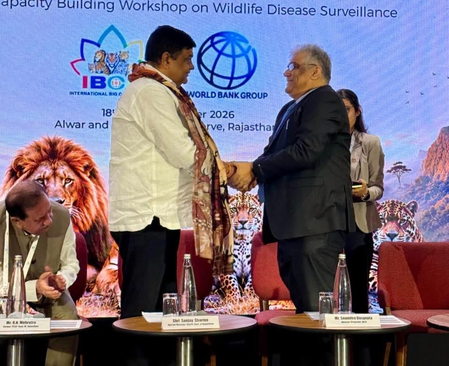
Jaipur, Nov 18 (IANS) Rajasthan Forest and Environment Minister of State (Independent Charge) Sanjay Sharma on Wednesday announced that compensation for the families of people who lose their lives in human-wildlife conflicts has been increased to Rs 10 lakh.
Sharma was speaking at a three-day national workshop on ‘One Health’ and wildlife disease surveillance, jointly organised by the International Big Cat Alliance (IBCA) and the World Bank at Hotel Sarovar Premiere.
The minister said that under the leadership of Union Environment, Forest and Climate Change Minister Bhupender Yadav, efforts towards forest and wildlife conservation were being pursued with firm commitment and dedication.
He emphasised that human, livestock, wildlife and environmental health are interconnected, making the ‘One Health’ approach essential.
He pointed out that 29 villages are located within the core area of Sariska Tiger Reserve, increasing the risk of disease transmission between wildlife and human populations.
To address this challenge, an initiative has been launched to vaccinate dogs within the reserve and surrounding villages against diseases such as Canine Distemper. In coordination with the Animal Husbandry Department, vaccination drives for livestock and dogs will also be undertaken in villages around the tiger reserve.
The Forest, Animal Husbandry and Health departments will strengthen their coordination to prevent disease transmission.
Sharma also proposed creating a dedicated cadre of wildlife veterinarians for tiger reserves and expanding internship and research opportunities for students of veterinary medicine and wildlife science. He said the three-day workshop would provide valuable insights into diagnosing diseases affecting wildlife, adding that effective wildlife health monitoring was essential for timely detection and prevention.
Highlighting Sariska’s conservation success, the minister said the tiger reserve had reached a stage in 2004 when its tiger population had effectively fallen to zero. However, sustained monitoring and conservation efforts by the Forest Department had helped restore the population to 58 tigers, including adults and cubs, and the numbers were continuing to grow.
He also highlighted the state’s efforts to conserve the Great Indian Bustard, Rajasthan’s state bird. The state government has decided to observe May 21 as Great Indian Bustard Day.
Chief Minister Bhajanlal Sharma has also announced the establishment of wildlife rescue centres in forest areas and specialised wildlife centres within tiger reserves.
During the workshop, retired Principal Chief Conservator of Forests and former Chief Wildlife Warden R.N. Mehrotra stressed the importance of timely identification of wildlife diseases, scientific monitoring and coordination among departments. Soumitra Das outlined the activities of the International Big Cat Alliance and said the workshop aimed to strengthen the disease surveillance capabilities of field officials working with big cat species.
Dr Anupam Joshi highlighted the World Bank’s support for the One Health initiative, while Chief Wildlife Warden K.C.A. Arun Prasad emphasised the need to further strengthen wildlife health and veterinary infrastructure in Rajasthan.
Chief Conservator of Forests (CCF) Sangram Singh Katihar said participants from 10 states were attending the workshop, including Deputy Conservators of Forests, wildlife veterinarians and members of the Sariska Tiger Reserve team.
The technical sessions on November 19 will feature experts from the Global Tiger Forum, National One Health Mission, National Institute of One Health, Wildlife Institute of India, the Ministry of Environment, Forest and Climate Change and other organisations.
Discussions will cover diseases affecting big cats, emerging pathogens, the human-livestock-wildlife interface and integrated disease surveillance, along with panel discussions.
On November 20, participants will undertake practical field sessions at Sariska Tiger Reserve. These will include demonstrations on biological sample collection, biosafety protocols, remote biopsy of large felids, sample preservation and transportation, carcass investigation and post-mortem examination.
Participants will also learn forensic evidence collection in cases of suspected poaching and poisoning. The workshop will conclude on November 20 with a closing session. Archana Bhardwaj delivered the vote of thanks.
–IANS
arc/dan