



Islamabad, Dec 29 (IANS) The political situation in both Pakistan-occupied Kashmir (PoK) and Pakistan-occupied Gilgit-Baltistan (PoGB) continues to be marked by a crisis of legitimacy. In PoK, traditional political structures are struggling to address public grievances, worsening the legitimacy deficit, while PoGB faces constitutional ambiguity that restricts democratic consolidation and leaves core governance questions unresolved, a report stated on Thursday.
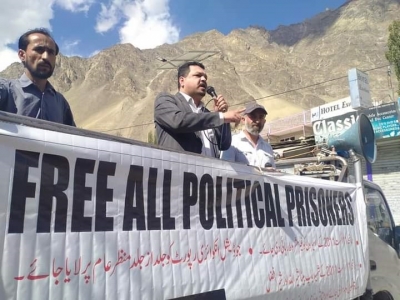
According to a report in ‘International Centre for Peace Studies’, “while 2025 saw widespread protests against governance and economic hardship” in the regions across PoK and PoGB, followed by a violent state response leaving at least 10 people dead, the political situation continues to remain tense in the beginning of the year 2026. The issues that brought the people of PoK to the streets remain unresolved.
“While the government in Islamabad along with the local governments, which act largely at its behest, has tried to arrive at some understanding with both Awami Action Committees (AAC),” of PoK and PoGB separately and agreed in principle to address their demands, it said, “the underlying issues of political disenfranchisement and economic marginalisation persist, keeping the political temperature high” in these regions.
The report mentioned that economic relationships between these territories and the Pakistani federation remain highly imbalanced, focusing on resource extraction without providing proportional benefits to the local communities.
It stressed that PoK has substantial hydropower potential, with projects such as “the Mangla Hydropower Project and the Neelum Jhelum Hydropower Project generating electricity primarily for Pakistan’s national grid”.
The report mentioned that PoK received a royalty of just 1.10 per unit of electricity produced from the Neelum Jhelum project under the December 2025 agreement, “a rate activists argue fails to compensate for the environmental and social costs borne by local communities”.
Similarly, in PoGB, it noted, despite key strategic projects— like the Diamer-Basha Dam and the China–Pakistan Economic Corridor (CPEC) promoted as a “guarantor of national prosperity”— local communities continue to face severe energy shortages, with some areas experiencing up to 22 hours of power outages daily.
“The development paradigm in both regions prioritises federally-directed mega-projects over local needs,” the report stated
Highlighting the federal government high-handed response to unrest in both PoK and PoGB, last year, the report said “The deployment of paramilitary forces from ‘mainland Pakistan’ — a move criticised by protests leaders as unnecessary given the fact that it could have been dealt with by the existing local police — further reinforced perceptions of the territories as occupied rather than autonomous regions.”
–IANS
scor/as