




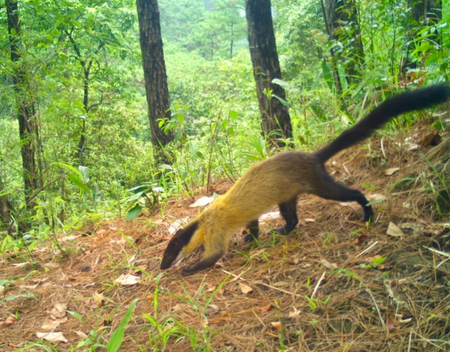
Kolkata, Oct 20 (IANS) The Wildlife Institute of India (WII) is upbeat after camera traps placed by its researchers recorded the critically endangered Chinese Pangolin close to Shillong in Meghalaya. This was for the very first time that the species was recorded in the WII’s study area, it has said.
“This rare record comes from our ongoing project “Assessment of Mammalian Assemblages in Meghalaya”, focusing on the Riat Laban and Laitkor reserve forests right on the urban edges of Shillong,” the institute has said.
“These peri-urban city forests harbour a remarkably unique and diverse assemblage of wildlife. Alongside the Chinese Pangolin, our cameras captured iconic species including the Large Indian Civet, Leopard Cat, Masked Palm Civet, Yellow-throated Marten, Indian Crested Porcupine, and Kalij Pheasant,” WII has said.
Urban-adjacent and city-fringe forests are often overlooked, yet they act as critical ecological refuges for species threatened by habitat fragmentation and urban development, researchers have highlighted.
“Finding a critically Endangered species like the Chinese pangolin sharing space with a rich suite of carnivores and small mammals proves that these urban forest patches are invaluable biodiversity strongholds that must be strictly protected and preserved,” the institute has said.
The discovery has also underscored the importance of conservation at these small, but immensely valuable forest patches in the outskirts of important urban centres.
The Chinese pangolin is native to the northern part of the Indian subcontinent, northern parts of Southeast Asia and southern China. Since 2014, it has been listed as critically endangered on the IUCN Red List.
The greatest threat to these animals is from poachers. Millions of these animals have been killed over the last few decades for their meat and scales. The scales are used in traditional Chinese medicine, though there is no scientific evidence of their being effective against any known disease.
India’s northeastern states also had a sizeable population of Chinese Pangolins at one point in time. These animals were then poached, and their scales illegally trafficked to Southeast Asian countries. While strong laws exist, enforcement is an issue, researchers and wildlife experts say.
“Those caught are normally couriers, who are let off after some time. The kingpins behind the trafficking syndicates seldom get caught. They succeed in shielding their networks that are worth hundreds of crores,” a forest official said.
They feel that the capture of these animals in camera traps set up by government bodies like WII will help in strengthening conservation efforts and may just help in pulling back such species from the brink of extinction.
–IANS
jg/dan