



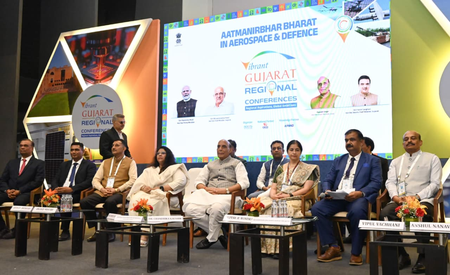
Vadodara, June 30 (IANS) Four defence companies on Tuesday signed memoranda of understanding (MoUs) worth a combined Rs 2,550 crore to invest in Gujarat’s defence sector during a seminar on ‘Atmanirbhar Bharat in Aerospace and Defence’ held as part of the second day of the Vibrant Gujarat Regional Conference (VGRC) for Central Gujarat in Vadodara.
The agreements were signed in the presence of Union Defence Minister Rajnath Singh at Gujarat State Fertilisers and Chemicals (GSFC) University, where the two-day regional conference concluded.
According to the organisers, the proposed investments will be made across Kheda, Rajkot, Vadodara and Ahmedabad districts and are expected to generate more than 4,000 employment opportunities.
The projects cover the manufacture of defence systems, defence equipment, aerospace tooling and engines, and unmanned aerial vehicle (UAV) systems and application hardware.
Dinesh Chandra Defence Systems Private Limited signed an MoU worth Rs 800 crore, Shreeram Aerospace and Defence LLP committed Rs 150 crore, Shree Khodiyar Heavy Engineering Private Limited signed an agreement worth Rs 100 crore, while SRK Tectronics LLP signed the largest MoU, valued at Rs 1,500 crore.
The MoU signing took place during the seminar, where representatives from industry, startups, academia, research organisations and the armed forces discussed strengthening India’s indigenous defence manufacturing capabilities and reducing import dependence.
Addressing participants, Singh invited direct engagement from the industry and startup ecosystem on issues related to self-reliance in defence manufacturing.
“If the startups or industries present here have any issues or suggestions regarding making India self reliant in the industrial and defence sectors, please let us know. Tell us what your expectations are from the government. We want to understand them,” he said.
During the interaction session, participants proposed measures, including the development of world-class testing facilities, creation of new testing infrastructure, strengthening Gujarat’s role in defence manufacturing, ensuring domestic availability of basic materials and establishing a defence corridor in the state.
Responding to a query from Neel Vaidya, founder of Amrut Defence, who said companies often face difficulties in identifying the appropriate end users for their products and services, Union Defence Minister Singh said he regularly interacts with defence startups and remains informed about their concerns.
“I regularly meet startups working in the defence sector. I stay informed about their issues and the challenges they face. Our officials are also present during these interactions, and necessary directions are issued immediately. Various conferences and programmes in this sector continue to be organised regularly. However, I would like to tell you that whether or not such conferences are held, and even if no meeting is scheduled, as a startup you can directly seek an appointment with the Defence Minister,” he said.
K. C. Sampat, Additional Industries Commissioner of state government, and Managing Director of iNDEXTb, said the discussions would focus on manufacturing defence products currently being imported and on expanding the role of micro, small and medium enterprises (MSMEs) in achieving that objective.
“MSMEs already make significant contributions to defence manufacturing by producing critical components and ensuring faster deliveries, adding that indigenisation of the defence sector is incomplete without MSMEs,” he said.
Hansraj Gajera, General Secretary of Laghu Udyog Bharati, said MSMEs have an important role in strengthening India’s defence manufacturing ecosystem and achieving self-reliance.
He noted that such enterprises possess the capability to supply critical components and spare parts, while Gujarat already has a strong industrial base with scope for further growth.
Commodore Manish Tripathi (Retd.), Chief Technology Officer (Systems) at IIT Gandhinagar, said the nature of warfare is evolving with the increasing importance of cybersecurity, artificial intelligence, autonomous systems, drone technology and secure communications.
“The traditional definition of warfare is changing. In today’s digital era, as the flow of information continues to expand rapidly, cybersecurity, artificial intelligence, autonomous systems, drone technology and secure communication systems are playing increasingly important roles in the defence sector,” he added.
He said that future defence technologies must address both current and emerging security requirements.
“Today, warfare is no longer confined to the battlefield. Information, cyberspace and emerging technologies have become equally significant. Therefore, the development of indigenous defence technologies is the need of the hour,” he said.
The seminar also featured a panel discussion on ‘From Import Dependence to Indigenous Capability: Building an Atmanirbhar Aerospace and Defence Ecosystem’, bringing together representatives from industry, academia, the armed forces and defence manufacturing organisations to discuss opportunities for expanding indigenous production.
Several defence startups were felicitated during the programme.
–IANS
mys/khz