



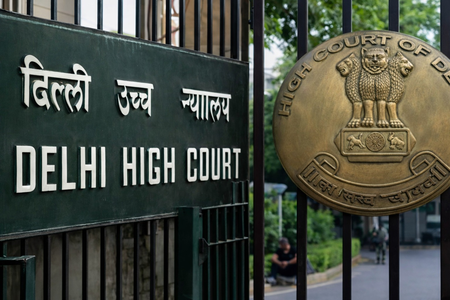
New Delhi, July 1 (IANS) The Delhi High Court on Wednesday upheld an earlier ruling declaring the National Stock Exchange (NSE) a “public authority” under the Right to Information (RTI) Act, holding that it is amenable to the transparency law as it is subject to deep and pervasive control of the Central government and the Securities and Exchange Board of India (SEBI).
A Division Bench of Justices C. Hari Shankar and Om Prakash Shukla dismissed an appeal filed by the NSE, affirming a 2010 single-judge ruling that had declared the stock exchange to be a public authority under Section 2(h) of the RTI Act.
“We affirm and uphold the judgment of the learned Single Judge. The appeal is dismissed, with no orders as to costs,” the Justice Hari Shankar-led Bench said.
The appeal had challenged the finding that the NSE falls within the ambit of the RTI Act despite being incorporated as a private company under the Companies Act.
The principal question before the Delhi High Court was whether the NSE is a “public authority” within the meaning of Section 2(h) of the RTI Act.
Rejecting the NSE’s contention that it is merely a regulated private entity, the Justice Hari Shankar-led Bench said the issue of governmental control already stood concluded by earlier judicial precedents concerning recognised stock exchanges.
“We agree with the learned Single Judge that the aspect of whether there is deep and pervasive government control over the NSEI stands concluded” by the earlier decision in K.C. Sharma v. Delhi Stock Exchange case, the latest judgment said.
It further held that the regulatory powers exercised under the Securities Contracts (Regulation) Act (SCRA) and the SEBI Act go far beyond ordinary supervision and establish sufficient governmental control to attract the RTI Act.
The Justice Hari Shankar-led Bench said that the recognition granted by SEBI under Section 4(3) of the SCRA had to be treated as an order of the Central government because SEBI exercises delegated powers under the statute.
“In view of the fact that Section 4(3) requires governmental recognition for a stock exchange to function as such, we agree with the learned Single Judge that the stock exchange has to be regarded as having been ‘established’ or, at the very least, ‘constituted’ by an order issued by the Government,” the judgment said.
Summarising its conclusions, the Delhi High Court held that the NSE is a “public authority” under the second part of Section 2(h) because of the government’s deep and pervasive control over it and also under the first part because SEBI’s statutory recognition is indispensable for the exchange to function.
–IANS
pds/dan