



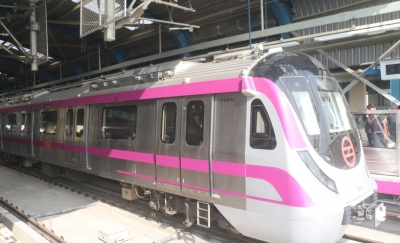
New Delhi, May 17 (IANS) In a major push to encourage the use of public transport and reduce dependence on private vehicles, the Delhi Metro Rail Corporation (DMRC) on Sunday announced a series of measures, including additional train trips, enhanced security arrangements, and expanded commuter facilities across the Delhi-NCR network.
According to the DMRC, 24 additional train trips will be introduced every Monday beginning May 18 through the deployment of six extra trains. The corporation said additional services may also be operated on other days, depending on passenger demand.
The move comes amid growing emphasis on energy security, sustainable mobility and environmental protection, with DMRC positioning metro services as a reliable alternative to petroleum-based road transport.
In an official statement, the DMRC said it is fully prepared to handle any likely increase in passenger footfall and will closely monitor travel patterns to ensure uninterrupted and efficient operations.
To facilitate smoother commuter movement, the Metro operator is also strengthening station management and security infrastructure. Measures include deployment of additional security personnel, operation of more ticket counters, activation of spare door frame metal detectors (DFMDs) and baggage scanners, and steps to reduce waiting time at frisking points during peak hours.
Highlighting the importance of integrated urban transport, the DMRC said its network provides seamless connectivity to railway stations, Interstate Bus Terminals (ISBTs), airport terminals, the Namo Bharat Regional Rapid Transit System (RRTS), the Noida Metro, and the Rapid Metro in Gurugram.
The Metro network also connects key commercial centres, government offices, educational institutions, tourism hubs and cultural landmarks across Delhi-NCR.
“From Chandni Chowk and Connaught Place to Cyber City, educational hubs and iconic landmarks, Delhi Metro continues to provide comprehensive urban accessibility across Delhi-NCR,” the statement said.
To improve first-mile and last-mile connectivity, the DMRC said it has developed an extensive ecosystem across 160 Metro stations, benefiting nearly one lakh passengers daily through e-autos, e-rickshaws, bike taxis, cab aggregators and bicycle rentals.
The corporation also highlighted the role of its DMRC Saarthi App, which offers integrated booking services for Metro tickets and last-mile transport through a single digital platform.
Recently, the DMRC, with support from Indian Oil Corporation Limited, launched hydrogen-based bus services in the Central Vista area to improve last-mile connectivity between Metro stations and government offices.
Additionally, around 1,500 Devi buses operated by the Delhi Transport Corporation are currently providing feeder connectivity at 52 Metro stations, with more buses set to be introduced progressively.
The DMRC also said parking facilities are operational at 126 Metro stations to support “park and ride” commuting and encourage people to shift from private vehicles to public transport.
The corporation further underlined its focus on digital ticketing solutions, including QR-code tickets, National Common Mobility Cards (NCMC), WhatsApp-based ticketing, and integrations with platforms such as Paytm, PhonePe, Amazon and IRCTC, along with services through the Open Network for Digital Commerce (ONDC).
The DMRC said the initiatives are part of its broader commitment towards sustainable urban mobility, enhanced commuter convenience and reducing fuel dependency in line with national priorities.
–IANS
sn/vd