




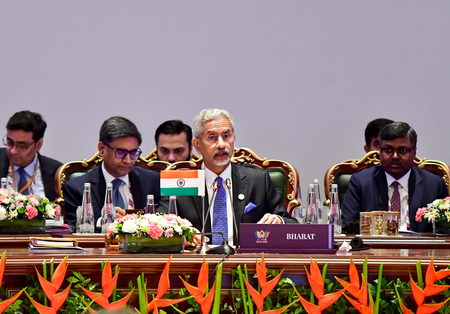
New Delhi, May 14 (IANS) Highlighting the fragile security environment in West Asia, External Affairs Minister (EAM) S. Jaishankar on Thursday said that persistent tensions in the region, along with threats to shipping routes and energy infrastructure, remain a matter of global concern.
Delivering the national statement at the BRICS Foreign Ministers’ Meeting in New Delhi under India’s 2026 chairship, the EAM said, “The conflict in West Asia merits particular attention. Continuing tensions, risks to maritime traffic, and disruptions to energy infrastructure highlight the fragility of the situation. Safe and unimpeded maritime flows through international waterways, including the Strait of Hormuz and the Red Sea, remain vital for global economic well-being.”
He also reaffirmed India’s “strong commitment” to the purposes and principles of the United Nations Charter.
“Respect for sovereignty and territorial integrity must remain the foundation of international relations. Dialogue and diplomacy are the only sustainable means of resolving conflicts,” the EAM said.
EAM Jaishankar further said that even as the challenges mount in the times of global uncertainties, the “multilateral system unfortunately weakens”. He said that the state of the United Nations, which is at its core, is “particularly worrisome”.
“With each passing day, the case for reformed multilateralism only gets stronger. This includes the reform of the UN Security Council in both the permanent and non-permanent categories. Continued delay comes at a high cost,” he added.
Meanwhile, speaking at the opening address of the meeting, EAM Jaishankar stressed the need for enhanced cooperation among BRICS member nations amid growing geopolitical and economic uncertainties.
“We meet at a time of considerable flux in international relations. Ongoing conflicts, economic uncertainties, and challenges in trade, technology, and climate are shaping the global landscape. There is a growing expectation, particularly from emerging markets and developing countries, that BRICS will play a constructive and stabilising role,” EAM stated.
“In this background, our discussions today are an opportunity to reflect on global and regional developments and to consider practical ways to strengthen our cooperation,” he added.
Several foreign ministers, including Iranian Foreign Minister Abbas Araghchi, Russian Foreign Minister Sergei Lavrov, Indonesian Foreign Minister Sugiono and senior representatives from BRICS nations and partner countries, are attending the meeting.
Marking Tehran’s first high-level diplomatic outreach since the conflict in West Asia began, Iranian Foreign Minister Araghchi arrived in New Delhi on Wednesday for a three-day official visit.
Araghchi is expected to hold wide-ranging bilateral talks with EAM Jaishankar, with discussions likely to focus on deepening the crisis arising from the conflict.
Araghchi arrived aboard an aircraft named ‘Minab168’, a symbolic reference to the 168 schoolgirls killed in a missile strike on a school in the Iranian city of Minab after the outbreak of the conflict in West Asia.
Following the worsening conflict in West Asia, Iran called on India– the current BRICS chair — to play an “independent role” to bring an end to US-Israel hostilities against Iran.
Earlier, Iran’s Deputy Foreign Minister Kazem Gharibabadi, who is currently in New Delhi to participate in the BRICS Foreign Ministers’ Meeting, said that Tehran views its active participation in mechanisms such as BRICS as a strategic step towards strengthening genuine multilateralism and promoting a more balanced and just international order.
Gharibabadi made the remarks while highlighting the significance of the BRICS platform amid ongoing discussions among member nations on global governance reforms, economic cooperation and the role of the Global South in shaping international affairs.
In a post shared on X, the Iranian Deputy Foreign Minister said the BRICS meeting presents an important opportunity for dialogue on the future direction of cooperation among developing nations.
Gharibabadi further said Iran’s participation in BRICS aligns with its broader strategic vision of enhancing equitable cooperation and contributing to a more inclusive international framework.
According to him, Iran possesses significant geopolitical, energy, scientific, transit and human capacities that can contribute meaningfully to the BRICS agenda.
“Iran, with its geopolitical, energy, transit, scientific, and human capacities, can play an effective role in the BRICS agenda for balanced development, economic security, regional connectivity, and amplifying the voice of independent countries,” he said.
The Iranian minister also stressed the importance of opposing unilateral coercive measures and sanctions, particularly those imposed by the United States, describing them as harmful to economic justice and development.
“In this path, opposition to America’s unilateral coercive measures and their illegal and anti-development effects is an inseparable part of defending economic justice and the rights of nations to development,” Gharibabadi added.
The escalating tensions in West Asia have also rattled global energy markets, with oil and gas prices surging after Iran effectively blocked the Strait of Hormuz — the strategic shipping corridor between the Persian Gulf and the Gulf of Oman that carries nearly 20 per cent of the world’s oil and LNG (liquefied natural gas) supplies.
–IANS
scor/sd/