



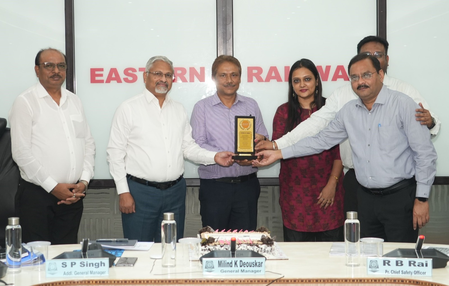
Kolkata, June 16 (IANS) Eastern Railway (ER) has been awarded the National Signalling and Telecommunications (S&T) Award 2026 by the Institution of Railway Signal Engineers (IRSE) for being the “Best Zonal Railway Showing Excellence in Kavach Deployment & Automatic Train Protection Implementation”.
“For decades, train operations during dense fog, heavy rain, or peak traffic hours placed an immense cognitive load on loco pilots, who had to constantly peer out to spot physical signals. The risk of accidental Signal Passing at Danger (SPAD), sudden train rollbacks, or tracking real-time movements across dense corridors remained a persistent challenge. The successful deployment of Kavach Version 4.0 — India’s indigenous Automatic Train Protection (ATP) system conforming to the highest international SIL-4 safety standards — has permanently solved these vulnerabilities,” a senior ER official said.
ER has set several golden benchmarks across Indian Railways by becoming the very first zonal railway to award and execute the EPC (Engineering, Procurement & Construction) contract for the implementation of Kavach on the high-density Mission Raftar Howrah–New Delhi High Density Route.
It is also the first railway zone to commission its portion of Kavach Version 4.0 on the Howrah–New Delhi corridor under Mission Raftar, and the first to commission Kavach Version 4.0 in automatic signalling territory. ER was also the first zone to successfully commission direct interfacing of Kavach with Electronic Interlocking systems.
“The massive project covered 260 route km and involved deployment across 47 stations, including 11 with electronic interlocking, six with major route relay interlocking and 30 with panel interlocking. Major stations such as Howrah, Liluah, Barddhaman, Asansol, and Sitarampur were successfully integrated into the Kavach network to ensure a fully protected journey. A major technological achievement within this network was the commissioning of Kavach on 118 WAP-5 and WAP-7 electric locomotives and one EMU, conforming strictly to SIL-4 safety standards,” the official said.
It also included the installation of nearly 7,900 RFID tags along the tracks, the deployment of 60 UHF radio towers, the laying of 520 kilometres of dedicated Optical Fibre Cable (OFC), and the establishment of Centralised Intelligent Kavach Monitoring Systems (CIKMS) at Howrah and Asansol for centralised monitoring and diagnostics.
The implementation was carried out on the Howrah–Barddhaman–Chota Ambana section, which is one of the most challenging railway corridors in the country, characterised by dense passenger and freight traffic, multiple-line territories, diverse signalling systems, and continuous train operations, another official said.
“Despite these complexities, ER successfully executed the project while maintaining the highest standards of operational safety and service continuity, ensuring zero disruption to daily commuter services. The system underwent rigorous field trials, validation exercises, and Independent Safety Assessor (ISA) audits before commissioning, ensuring compliance with internationally accepted SIL-4 safety requirements,” he added.
Passengers can now travel with ultimate peace of mind, experiencing smoother journeys, better punctuality, and an invisible, foolproof shield protecting them at speeds up to 160 kmph, the official added.
“Travelling by train is now safer, smarter, and more reliable than ever before on our most crowded routes. We are deeply committed to continuing this journey of modernisation to build a world-class railway network,” said Shibram Majhi, CPRO, Eastern Railway.
–IANS
jayanta/uk