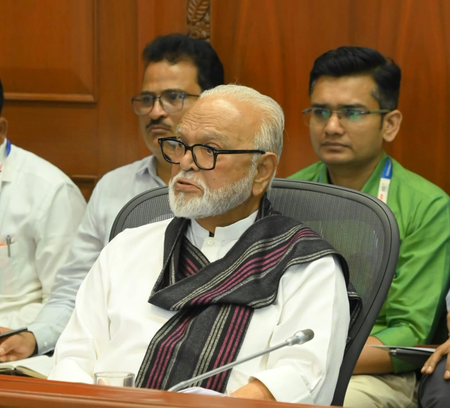




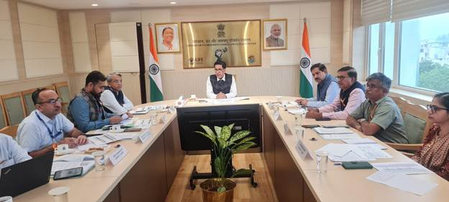
New Delhi, Oct 23 (IANS) Union Environment Secretary Narendra Bhooshan on Friday reviewed the action plans of the Uttar Pradesh government and urban local bodies to address air pollution in Delhi-NCR and winter preparedness.
The Environment, Forest and Climate Change Secretary reviewed various interventions such as redevelopment of roads, traffic decongestion at hotspots and deployment of electric buses and EV charging infrastructure, said a statement.
The UP government presented 11 key initiatives taken so far and the activities planned to achieve the saturation of air quality improvement interventions, addressing various sources of air pollution, namely road dust, construction and demolition (C&D) activities, open burning of biomass, vehicular pollution, traffic decongestion, industrial pollution, greening, paddy stubble management.
The State government, in coordination with various agencies and local bodies, has already implemented several measures which have achieved considerable progress, said the statement.
Bhooshan also reviewed measures for establishing the solid waste processing facilities for processing of 100 per cent solid waste generation, remediation of legacy waste dump sites, C&D waste processing facilities and secondary collection centres, monitoring and enforcement of air pollution control measures at construction sites and industries.
The meeting came on a day when a team led by the Chairperson, Commission for Air Quality Management (CAQM) in NCR and Adjoining Areas, visited thermal power and CBG plants, Krishi Vigyan Kendra (KVK), farm fields and biomass plant in Ropar, Hoshiyarpur and Amritsar in Punjab to review steps for stubble management.
The team reviewed the preparedness and took stock of various in-situ and ex-situ measures being implemented on the ground for effective paddy straw management and prevention of stubble burning incidents during the ongoing paddy harvesting season, the statement said.
The CAQM directed the state authorities to achieve co-firing targets in thermal power plants with special focus on ensuring compliance with emission norms. During the visit to KVK, the team saw demonstration of machinery for in-situ and ex-situ use.
The team also assessed the adequacy and availability of machinery to facilitate farmers in managing paddy residue. In addition, the team reviewed the arrangements and mechanisms in place for the maximum utilisation of paddy straw in thermal power plants and biomass plants utilising paddy stubble as part of ex-situ management.
–IANS
rch/uk