



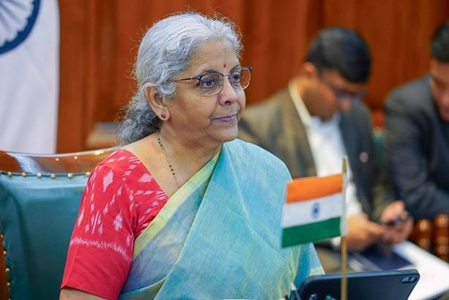
New Delhi, Oct 19 (IANS) Finance Minister Nirmala Sitharaman has said that the recent weakness in India’s stock market is partly linked to the ease with which investors can sell their holdings, while asserting that the economy’s underlying fundamentals remain sound, according to a report.
On the sidelines of the IMF and World Bank annual meetings, FM Sitharaman said that because liquidity is easy to access, people are exiting easily, according to a CNBC report.
“India’s economic fundamentals remained sound, but sustained capital outflows could pose a significant challenge in 2027,” according to her.
However, domestic equity benchmarks have declined nearly 12 per cent so far this year even as the economy continues to grow amid trade uncertainty and geopolitical tensions.
In addition, the Finance Minister identified continued capital outflows as one of the biggest risks facing India in 2027.
India has emerged as a market outside the main artificial intelligence investment boom, while Taiwan and South Korea have attracted stronger investor interest due to their exposure to companies linked to the technology, according to her.
“The flight of capital toward AI and the US which otherwise moves toward different countries for different sectoral investments, is a concern,” she told CNBC.
Despite the shift in global investment flows, she said India would not be hurt if a collapse in the global AI boom triggered a wider market sell-off.
In addition, foreign portfolio investors (FIIs) have sold more than $33 billion worth of Indian equities so far this year, according to data from depository NSDL, while foreign investors have withdrawn substantial amounts from domestic equities.
In the previous session (October 16), FIIs turned net buyers after 15 straight sessions of selling and bought equities worth about Rs 1,166 crore, while DIIs ended their 45-session buying streak with net sales of around Rs 3,661 crore.
FM Sitharaman also said India had not received the AI kind of investments coming into different jurisdictions, suggesting the country has less exposure to a reversal in investments linked to the technology.
She further stated that India was no longer a laggard in advanced technology and was investing in semiconductor manufacturing.
–IANS
ag/