




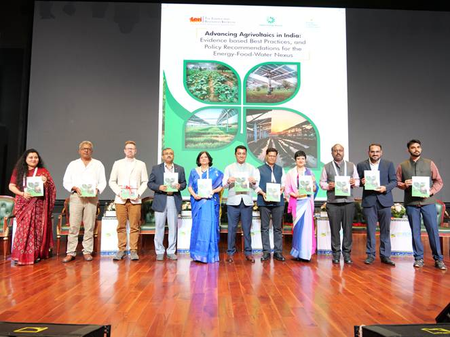
New Delhi, Oct 23 (IANS) India brought the priorities of farmers and the Global South to the heart of the dialogue at the 7th AgriVoltaics World Conference 2026 hosted by the Ministry of New and Renewable Energy, which concluded here on Friday.
Three days of scientific exchange, farmer experiences and industry engagement sharpened the focus on a shared opportunity of using agricultural land to produce food and solar power, strengthen farm incomes and advance the clean energy transition.
The conference highlighted India’s contribution as a platform for connecting research, field experience and international partnerships.
Policymakers, researchers, industry leaders, development partners and farmers examined how agrivoltaics can respond to the linked challenges of food security, energy access and climate resilience across India and the Global South.
The focus was firmly on implementation. Discussions examined agro-climatic zoning, crop selection, water-use efficiency, innovative financing and technology, with farmer-centred models at the core.
The deliberations reinforced the need for solutions that countries can adapt to their own agricultural conditions and development priorities.
A session co-convened by the Indian Council of Agricultural Research (ICAR) and the International Water Management Institute (IWMI) examined how agro-climatic zoning can guide agrivoltaic deployment.
Discussions covered shade-tolerant crops, water-use efficiency indices and the microclimatic impacts of solar arrays across different agro-climatic zones.
These exchanges placed scientific evidence at the centre of expansion. India’s engagement in this research dialogue offers a basis for wider knowledge exchange with Global South partners seeking to integrate solar power with productive agriculture.
Location-specific evidence will be essential to identifying what works for farmers and where it can be deployed effectively.
A dedicated session led by GIZ brought progressive farmers, Farmer Producer Organisation (FPO) federations and rural entrepreneurs into the discussion.
Participants shared experiences from agrivoltaic installations, covering operational lessons, revenue diversification and maintenance practices.
Their message gave the deliberations a clear practical direction: project design must respond to farmers’ needs and field conditions.
For India and other Global South countries, economically viable models that sustain agricultural production will be central to wider adoption. Farmer experience must help shape how projects are designed, financed and operated.
Presenting an overview of the conference proceedings and key outcomes, Ashish Khanna, Director General of International Solar Alliance (ISA), highlighted opportunities to advance agrivoltaics through research, innovation and international collaboration.
Addressing participants at the closing ceremony, Mayank Tewari, Ministry of New and Renewable Energy (MNRE) Additional Secretary, emphasised the importance of carrying the deliberations forward through continued collaboration and practical action.
The discussions brought renewed attention to the contribution India can make through shared learning and partnerships.
Connecting Indian research and farmer experience with international expertise can help develop agrivoltaic approaches suited to diverse agricultural and energy needs across the Global South.
Dignitaries presented Excellence Awards recognising outstanding contributions to the agrivoltaics sector.
The National Agrivoltaics Pitch-Hub Award recognised promising enterprise and start-up innovations with the potential to advance viable solutions.
Best Paper Awards across six scientific themes honoured research spanning system design, agronomy, monitoring, business models and socio-economic equity.
The awards recognised the researchers, innovators and entrepreneurs working to turn scientific knowledge into practical advances for agriculture and renewable energy.
The closing ceremony marked the formal handover of hosting responsibility for the 8th AgriVoltaics World Conference in 2027 to France.
The handover carried forward the momentum built in New Delhi and the continuing international effort to share knowledge, strengthen partnerships and advance agrivoltaic solutions across diverse farming contexts.
–IANS
sps/khz