



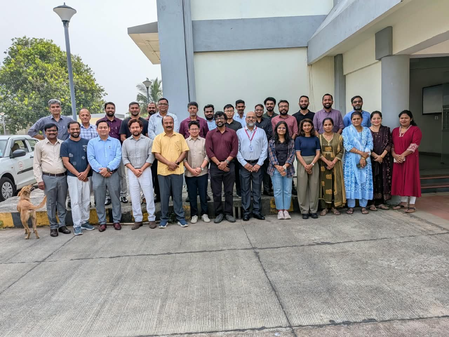
Kolkata, Nov 4 (IANS) The first batch of 16 members of the 46th Indian Scientific Expedition to Antarctica (46-ISEA) has embarked on its journey, the National Centre for Polar and Ocean Research (NCPOR), a laboratory under the Ministry of Earth Sciences said on Wednesday, officials said.
“The team will be carrying forward India’s commitment to advancing polar science, exploring the icy frontiers and strengthening our understanding of Antarctica,” it added.
The team comprises scientists and researchers from across the country.
Among them is Athira A.S., a research scholar at the ICAR–Central Institute of Fisheries Technology (ICAR-CIFT) in Kochi.
She will be stationed at the Maitri Research Station in Antarctica to undertake research on microbial diversity in the Antarctic terrestrial ecosystem.
Her research forms part of the project titled “Contaminant Load Evaluation in Antarctic Natural Systems (CLEAN-ANT)” (ISEA-63), coordinated by NCPOR.
The collaborative research initiative between NCPOR and ICAR-CIFT brings together expertise in polar research, aquatic microbiology and environmental microbiology.
“Athira’s research will focus on “Actinomycete Diversity in Antarctic Soil”, with the objective of isolating and characterising actinomycetes from Antarctic soil samples to assess their diversity and distribution under the extreme environmental conditions of the Antarctic terrestrial ecosystem,” a statement from ICAR-CIFT said.
Actinomycetes are a group of prokaryotic organisms classified as bacteria, characterised by their filamentous structures and ability to decompose complex organic materials, particularly in soil and marine environments.
They are significant components of the microbial community, especially under conditions of high pH, temperature, or water stress.
“A key component of the study is to explore the potential of these microorganisms to produce bioactive compounds, particularly antimicrobial substances, including antibiotics,” the institute said.
Actinomycetes are an important group of microorganisms known for their ability to produce biologically active natural compounds.
Investigating their diversity in the relatively unexplored Antarctic environment could provide valuable insights into microbial adaptation and help identify microorganisms with potential novel bioactive properties.
The findings are expected to enhance understanding of microbial diversity in Antarctic terrestrial ecosystems and contribute to research on extreme-environment microorganisms as potential sources of novel bioactive compounds.
“Athira’s participation in this prestigious national scientific expedition marks an important milestone for ICAR-CIFT in expanding its research activities into polar microbial biodiversity and bioprospecting,” ICAR-CIFT has said.
Two meteorologists from Shillong in Meghalaya will also be part of the expedition.
Partik Kumar and Dheeraj Chaudhary, from the IMD’s Meteorological Centre in Shillong, will represent the department in the polar mission.
Data collected from that region will help track climate variability and weather patterns across the world.
The focus of 46-ISEA is “Climate Change and its signatures in Antarctica”.
While NCPOR operates two year-round stations, Maitri and Bharati, in Antarctica for scientists to carry out research activities, reaching them is restricted between November and March (in the next calendar year), due to its peculiar geographic position.
–IANS
jg/khz