



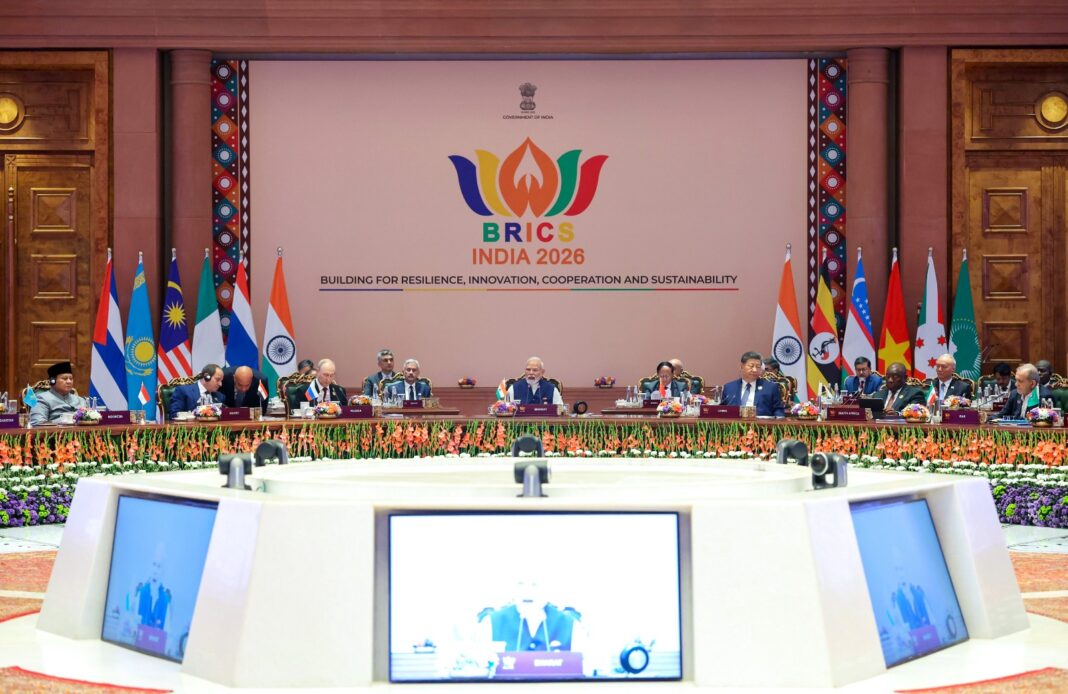
India convenes the BRICS leaders’ summit in New Delhi this weekend, the centrepiece of a chairship that has run for the better part of a year and the first full leaders’ gathering since the bloc’s expansion to eleven members. The meeting at Bharat Mandapam carries unusual weight—not merely as diplomatic theatre, but as a test of whether a fractious grouping can still deliver.
The central question is whether leaders can agree on a joint declaration. Consensus has proved elusive; a ministerial meeting earlier in the chairship cycle closed without a joint statement amid differences over West Asia. Bridging those gaps—holding together a bloc that now spans from Tehran to Abu Dhabi—would be a genuine win for Indian diplomacy. The language under negotiation is expected to deplore aggression without naming any country and to stress that dialogue and diplomacy remain the way forward. Whether that calibration holds is the first test of India’s convening power.
On finance, the substance lies in infrastructure, not ideology. India is not pursuing a common BRICS currency; officials have been explicit that the goal is expanding payment choices, not displacing the dollar. The proposals on the table are practical: a technical bridge connecting domestic fast-payment systems and interoperability between central bank digital currencies. India’s Unified Payments Interface has become a widely cited model for cross-border payment connectivity. Local-currency settlement has already advanced bilaterally, with the overwhelming majority of Russia-India trade now conducted in rupee and rouble. A larger role for the New Development Bank in mobilising private capital and expanding local-currency financing rounds out the agenda.
Technology cooperation is emerging as another pillar. A BRICS Network on Digital Agriculture, coordinated initially by IIT Delhi, would deploy artificial intelligence, geospatial intelligence and IoT-enabled monitoring for agricultural applications. Member states have adopted guiding principles on smart grids and energy storage and moved to establish a Digital Centre of Excellence. A Startup Innovation Fund, an Incubator Network and a shared scientific research repository are also taking shape. The framing is deliberate: AI as a development tool for the Global South, not a geopolitical weapon.
Challenges persist. Divisions over West Asia could yet derail the declaration, and the gap between announcements and delivery in cross-border projects remains a familiar frustration. The bloc’s expansion, while a statement of reach, has also complicated decision-making. Yet the trajectory matters. India has used its chairship not to impose a singular vision but to stitch together workable consensus from a diverse and expanding bloc representing roughly half the world’s population and a substantial share of global GDP.
The summit is not an end point but a handover. The test for India is whether it converts a year of chairship into durable influence—and whether the declaration that emerges this weekend carries commitments that survive the photographs. If dialogue and diplomacy are to mean anything, they must be matched by delivery in the months that follow.