




New Delhi, Dec 24 (IANS) Legally binding commitments on professional services under various free trade agreements (FTAs) would unlock global markets for Indian professional services, an official statement said on Wednesday.
Commerce Secretary Rajesh Agrawal emphasised the importance of enhanced stakeholder coordination, reforms in the domestic ecosystem, and legally binding commitments on professional services under various FTAs.
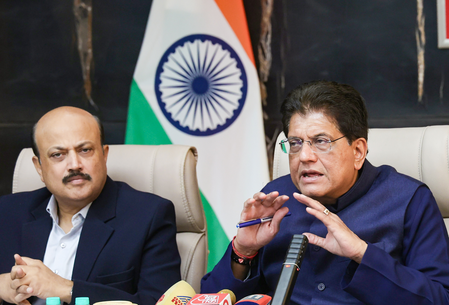
Speaking at the ‘Chintan Shivir on Professional Services’ here, Commerce Secretary further underscored the importance of services trade for India’s economic growth, noting its strong contribution to domestic value addition along with merchandise exports.
Agrawal emphasised that India’s demographic dividend offers immense potential to meet the rising global demand for professional services.
He stated that to realise this potential, it is critical to adopt global best practices and equip professionals with upgraded skills aligned with evolving global market needs and technological developments.
The Commerce Secretary said that greater openness in international trade in professional services would enhance competitiveness in India’s economy. He encouraged professional bodies to organise and participate in international conferences to enable knowledge sharing and provide platforms for enhanced collaboration.
The Chintan Shivir provided an opportunity for professional bodies to exchange ideas on global best practices as well as practices followed among peers in India.
“Areas were identified where professional bodies could re-examine existing rules and regulations governing professional practice and undertake appropriate changes in training and skill upgradation programmes to ensure alignment with evolving developments in artificial intelligence and technology,” according to a Commerce Ministry statement.
In this regard, the ICAI playbook was widely appreciated for the dynamic and market-oriented hard and soft infrastructure put in place, including chapters, an international directorate and certification courses focused on technology and AI.
The efforts of the Indian Nursing Council to enable Indian nurses to gain greater access to international markets were acknowledged, particularly in view of regulatory challenges in many advanced economies in the health sector.
Discussions on Mutual Recognition Agreements (MRAs) centred on key challenges associated with entering into MRAs as well as ensuring effective utilisation of existing MRAs. In the context of Global Capability Centres and the rapid scaling of digitally delivered services, the role of MRAs in India’s future professional services export strategy was also deliberated.
On leveraging FTAs, discussions focused on future-proofing the digital delivery of professional services, in addition to mobility-related provisions and horizontal domestic regulations related to qualification requirements and procedures.
—IANS
na/