




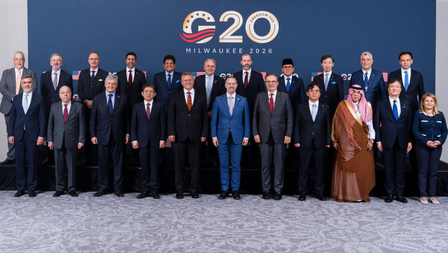
Milwaukee, Oct 2 (IANS) G20 countries have reached consensus on condemning the weaponisation of food through coercive trade actions, US Trade Representative Jamieson Greer announced, calling it an important step towards preventing agricultural products from being used for economic or political pressure.
The agreement emerged after days of discussions at the G20 Trade Ministers’ Meeting in Milwaukee, where the United States put the issue on the agenda of the world’s major economies.
“After days of discussions, and a willingness on the part of the members to act, we are pleased to have reached consensus on the G20 statement on the weaponization of food through coercive trade actions, and we’ll release it later today,” Greer told reporters.
“This is an important step towards ensuring that agricultural products are not used as a tool for economic or political coercion,” he said.
Greer said the issue was taken up during the US presidency of the G20 because trade in food, agricultural products and agricultural inputs can be used to exert pressure on countries.
“Throughout the US presidency, we discussed in G20 sessions how trade and food, agricultural products, and agricultural inputs can be weaponized as a tool to exert coercive pressure for economic or political reasons, threatening livelihoods in targeted countries, distorting competition, and eroding trust in the global trading system,” he said.
Greer said weaponisation of food was a new subject for G20 discussions, but the problem itself was not new.
“G20 members had a unique opportunity this week to make a collective statement condemning food weaponization to bring more awareness to this important topic and help mitigate its use and effects globally,” he said.
The consensus on food stood in contrast to disagreements among G20 members on two other major issues pushed during the Milwaukee ministerial, forced labour and structural excess capacity.
Greer said the United States and other members could not secure consensus on a statement addressing forced labour in global supply chains.
“It is unfortunate that we could not reach consensus on the forced labor statements,” he said.
Greer said a smaller group of trading partners would instead issue a joint statement on eliminating forced labour from global supply chains.
“I will say that we will be able to release with a handful of trading partners a joint statement on eliminating forced labor in global supply chains, although it did not achieve consensus with all of the G20s,” he said.
The G20 also failed to agree on a statement addressing structural excess production, although Greer said there was broad recognition that the problem required action.
Excess capacity, he said, was widely recognised as a problem in steel and also affected automobiles, batteries, solar panels, chemicals and other sectors.
“We just came out of a session on this a little while ago, and nearly all countries agreed that this is an issue that requires action,” Greer said.
“And nearly all countries agree that our current system of trade remedies or responses is inadequate to solve this problem,” he added.
Greer said the United States would continue discussing excess capacity with like-minded trading partners after the Milwaukee meeting.
“It’s unfortunate we couldn’t reach consensus on a statement on this issue to address structural excess capacity and production, but this is the type of question we should be addressing at the G20, whether you can get consensus or not,” he said.
The United States is hosting the G20 in 2026. Greer said the grouping represents roughly 85 per cent of global GDP and two-thirds of the world’s population, giving it a potentially significant role in addressing problems in the global trading system.
The Milwaukee trade ministerial is part of preparations for the G20 Leaders’ Summit in Miami later this year. Trade ministers have discussed food security, forced labour, excess production and possible changes to established principles governing international trade.
–IANS
lkj/rs