



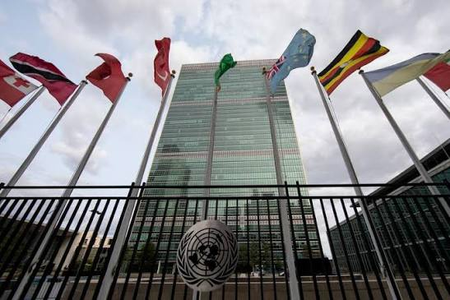
United Nations, Sep 28 (IANS) Speeches by the world’s leading economies at the UN General Assembly revealed a shared fear that the international order is breaking down, but exposed deep divisions over whether the answer lies in stronger multilateralism, greater national sovereignty or forceful unilateral action.
Across five days of debate, the 19 national members of the G20 described a world disrupted by wars, economic coercion, fractured supply chains, technological rivalry and declining trust in international institutions.
US President Donald Trump defended military action and an “America First” approach. He criticised international organisations and said the United Nations must “stop imposing the far-left agenda of globalist bureaucrats who nobody ever elected”.
China offered a sharply different prescription. Vice President Han Zheng called for the post-war order to be protected and disputes to be resolved through dialogue.
“The world wants peace, not war,” Han said. He warned that “protectionism produces no winners” and opposed decoupling and the severing of supply chains.
Russian Foreign Minister Sergei Lavrov described the emergence of the Global South and East as sovereign centres of power. He accused Western countries of trying to preserve privileges acquired through centuries of dominance.
France, Germany, Italy and Britain defended international cooperation but said existing institutions must adapt.
French President Emmanuel Macron asked whether countries wanted “a return to the law of the jungle” or “a civilized international society”. German Foreign Minister Johann Wadephul called for a UN capable of “resolving conflicts — rather than merely managing them”.
Italian Deputy Prime Minister Antonio Tajani said alliances should be seen as bridges rather than walls. British Prime Minister Andy Burnham focused on disinformation, cyberthreats and the risks posed by artificial intelligence.
Brazilian President Luiz Inácio Lula da Silva said the UN’s credibility had been damaged by the Security Council’s paralysis.
“We all know that there will be no winners on the battlefield. Diplomacy is the only option,” Lula said.
Mexico linked peace to inclusive development. Foreign Minister Roberto Velasco Álvarez said: “Peace cannot be decreed or imposed; it is built with social justice.”
Argentina offered the strongest rejection of the existing system. President Javier Milei called the UN a “useless organization” that sustained what he described as an arrogant bureaucracy. He argued that international cooperation should not become subordination.
India warned that countries far removed from battlefields were paying for wars they did not start. External Affairs Minister S. Jaishankar pointed to disruptions in food, fuel, fertiliser, finance and commerce.
“Those most impacted often have the least say,” he said. India called for de-escalation, uninterrupted energy and trade flows, and an end to prolonged conflicts.
Australia, Canada, Indonesia and South Korea presented middle powers as potential stabilisers between competing blocs.
Australian Prime Minister Anthony Albanese said the UN’s mission could not be left solely to great powers, wealthy countries or technology companies.
Canadian Foreign Minister Anita Anand said: “We are facing a rupture, not a transition.” She argued that countries could no longer remain overly dependent on any single partner.
Indonesia said effective multilateralism must produce visible benefits for families, workers and farmers.
“The answer to imperfect multilateralism is not less multilateralism; it is a stronger and better multilateralism,” Foreign Minister Sugiono said.
South Korean President Lee Jae Myung called for peaceful coexistence on the Korean Peninsula and renewed dialogue between North Korea and the United States. Japan, meanwhile, stressed resilient Indo-Pacific supply chains, nuclear disarmament and stronger international institutions.
South Africa placed inequality at the centre of the debate. It said the richest 10 per cent controlled roughly three-quarters of global wealth while developing countries remained constrained by debt and an unequal climate-finance system.
Saudi Arabia linked Gulf stability to global energy security and trade. Türkiye said international law must not be applied differently to powerful and weaker countries.
The speeches showed that G20 governments broadly agreed on the symptoms: wars are spreading economic pain, technology is concentrating power and international institutions are losing public confidence. Their proposed remedies, however, ranged from rebuilding multilateral institutions to asserting national control and strategic autonomy.
The G20 comprises 19 countries, the European Union and the African Union. Its members account for about 85 per cent of global economic output, more than 75 per cent of international trade and roughly two-thirds of the world’s population.
–IANS
lkj/rs