




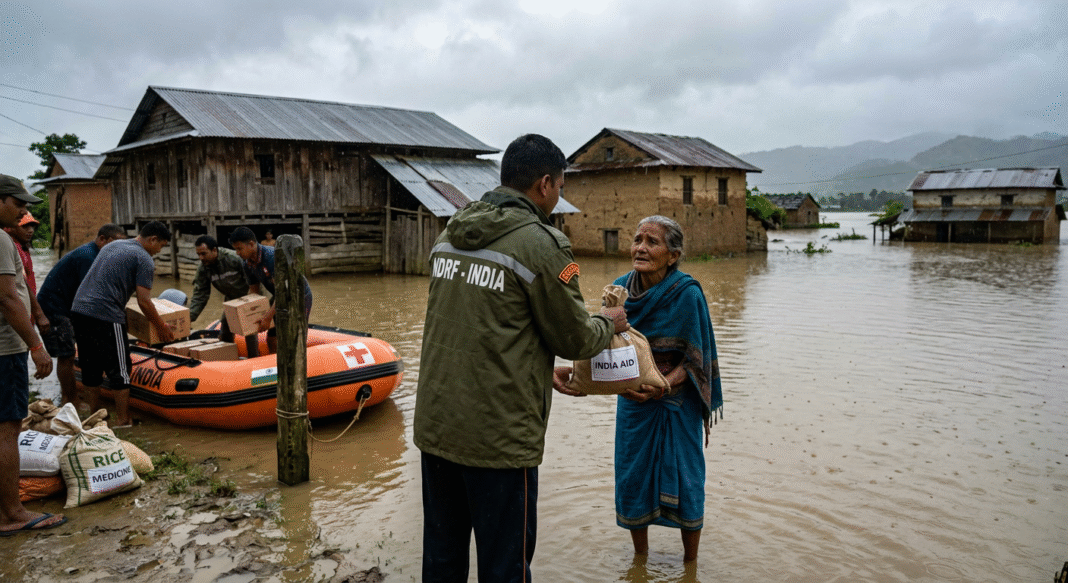
The Himalayan nation of Nepal is once again submerged in sorrow. Torrential monsoon rains have swollen rivers beyond their banks, triggered catastrophic landslides, and swept away entire villages in the mountainous terrain. The death toll has crossed two hundred and continues to climb, while the scale of destruction—homes flattened, bridges collapsed, farmlands buried under debris—paints a grim picture of nature’s fury unleashed upon a fragile landscape. For India, this tragedy is not merely a foreign news item; it is a crisis in the neighbourhood that demands both compassion and strategic clarity.
The human cost extends beyond Nepal’s borders. Among the dead and missing are foreign nationals who had come to the Himalayan republic as tourists, trekkers, and pilgrims. Reports indicate that several overseas travellers remain unaccounted for, their fates uncertain as rescue teams battle treacherous terrain and damaged infrastructure. Australian nationals are among those confirmed missing, a sombre reminder that natural disasters in the Himalayan belt carry global consequences. The Australian government has confirmed that a number of its citizens were in the affected areas, with consular teams working alongside Nepalese authorities to locate them. For the families waiting in distant continents, every hour is an eternity.
India’s response has been characteristically swift. Under the framework of its “Neighbourhood First” policy, New Delhi has dispatched emergency relief materials, including medicines, tents, tarpaulins, and water purification systems. Indian rescue teams, drawing on the hard-won expertise of the National Disaster Response Force, have been deployed to assist in search and recovery operations. The Indian Air Force has mobilised helicopters to reach areas cut off by washed-out roads. This is the India that repeatedly demonstrates its role as the region’s first responder—whether in earthquakes, cyclones, or floods.
Yet the gesture carries deeper significance. Nepal occupies a unique and sensitive position in India’s geopolitical calculus. Wedged between the two Asian giants, Kathmandu has often been a theatre where Indian and Chinese influence contend. In recent years, Nepal has pursued a delicate balancing act, seeking economic leverage by engaging with Beijing’s Belt and Road Initiative while maintaining the deep civilisational, cultural, and people-to-people ties that bind it to India. In such a context, disaster relief becomes more than humanitarianism; it is a reminder of the unbreakable bonds of geography and kinship that no amount of strategic hedging can sever.
However, the floods also expose uncomfortable truths. The very rivers that bring life to the Indo-Gangetic plains originate in Nepal’s fragile Himalayan ecosystem. The flooding in Nepal is a warning sign for downstream India as well. Deforestation, unplanned urbanisation, and climate change are accelerating the frequency and intensity of such disasters. A coordinated approach to water management, early warning systems, and sustainable infrastructure in the Himalayan watershed is no longer a matter of goodwill; it is a matter of survival for both nations.
The broader context of India-Nepal relations inevitably frames such relief efforts. Nepal has sought to balance its ties between New Delhi and Beijing, engaging with Chinese infrastructure initiatives while maintaining deep civilisational bonds with India. Yet the gap between announcements and implementation in cross-border Himalayan projects—whether funded by China or others—remains a persistent frustration for Kathmandu. Nepalese officials have publicly noted that Chinese financial commitments have often been slow to materialise, which underscores a larger truth: grand pledges matter little without on-the-ground delivery. For India, the challenge is not to compete in a visibility contest, but to build lasting institutional resilience through joint river-basin management, real-time hydrological data sharing, and community-based disaster preparedness that benefits both sides of the border.
For the Indian diaspora, the floods in Nepal are a call to look beyond the headlines. The Himalayan region is the common heritage of the subcontinent, and its ecological stability underpins the water security of hundreds of millions. The monsoon that brings devastation to Nepal will also fill the reservoirs of Bihar and Uttar Pradesh. The presence of Australian and other foreign nationals among the missing underscores that this is not merely a regional crisis but a global one. In that sense, the geography of grief is shared across continents.
As the floodwaters recede, the real test will begin. India must remain engaged not just as a rescuer but as a partner in rebuilding. The memory of assistance rendered in the darkest hours often lingers longer than the most eloquent diplomatic communiqués. In the end, it is not the quantum of aid but the constancy of friendship that will define India’s standing in its Himalayan neighbourhood—and the world’s confidence in the region’s resilience.