Washington, July 9 (IANS) The global economy has remained resilient despite the economic shock triggered by the Middle East conflict, with artificial intelligence-led investment and productivity gains helping offset the impact of higher energy and commodity prices, the International Monetary Fund (IMF) said on Thursday, while cautioning that uncertainty remains exceptionally high.
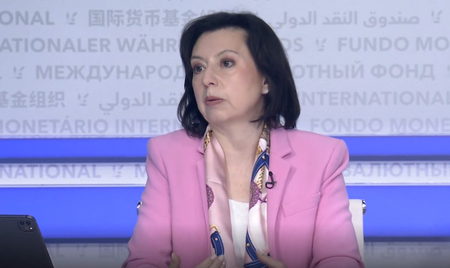
Speaking at the IMF’s regular press briefing, Julie Kozack, Director of the IMF’s Communications Department, said the world economy has successfully weathered multiple shocks over recent years, including the ongoing conflict in the Middle East.
“The global economy has been resilient. It’s faced many shocks over the last several years. It has weathered the shock of the Middle East war, as well,” Kozack said.
She said the resilience reflects two opposing forces acting on the global economy.
“We have the negative supply shock from the war, which has pushed up commodity prices, particularly energy, fertiliser and food prices.”
At the same time, she said, “we have a positive demand and productivity shock, which is coming from the technology cycle and particularly AI-led investment.”
“There’s two forces that are pulling the global economy in somewhat different directions, and the overall impact has been a resilient global economy,” Kozack said.
Despite that resilience, the IMF warned that uncertainty remains elevated and that the economic impact of the conflict has not been evenly distributed.
“We still anticipate that uncertainty will remain elevated,” Kozack said.
She noted that countries most affected by the conflict are commodity importers with limited fiscal space, which have been hit by higher prices for fuel, fertiliser and food while benefiting less from the productivity gains associated with advances in technology.
The IMF official also outlined the assumptions underpinning the Fund’s latest World Economic Outlook, released on Wednesday. The July forecast assumes that transit through the Strait of Hormuz begins to normalise in the middle of July and that the average oil price in 2026 will be about 89 US dollars a barrel.
“Those are the assumptions that have gone into the July WEO update,” Kozack said, adding that the IMF will continue to assess developments in oil markets, commodity prices and shipping through the Strait of Hormuz to determine their implications for the global economy.
She said the current forecast does not assume an immediate return to pre-war conditions, reflecting the continued uncertainty surrounding the conflict and global energy markets.
The IMF released its updated World Economic Outlook on Wednesday, revising growth forecasts for several major economies while highlighting the risks posed by geopolitical tensions and volatile commodity markets. The Fund has increasingly emphasised the role of uncertainty in shaping global economic prospects.
–IANS
lkj/ksk/dan