



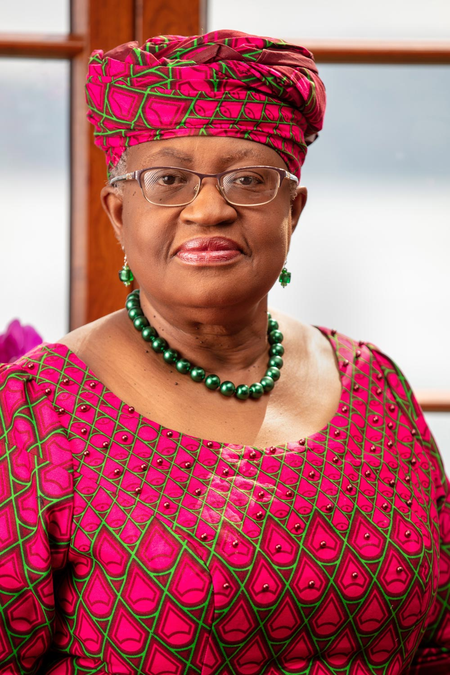
Washington, Oct 5 (IANS) Global trade is proving unexpectedly resilient despite aggressive US tariffs, the Iran war, high energy prices and growing strains on the rules-based trading system, World Trade Organization chief Ngozi Okonjo-Iweala has said, pointing to an AI-driven surge in commerce while warning that the system remains vulnerable.
The WTO Director-General said 72 per cent of world goods trade continues to take place under WTO most-favoured-nation terms, offering businesses stability and predictability even as traditional trading rules come under severe pressure.
She also said global goods trade has significantly outperformed WTO forecasts, with artificial intelligence-related products accounting for 42 per cent of last year’s growth.
“I will be very truthful and say that even we are surprised by the resilience and grateful for it,” Okonjo-Iweala said in an interview with CNN.
The interview came against the backdrop of a fundamental shift in US trade policy under President Donald Trump, heightened tensions between Washington and Beijing, disruption to energy markets from the Iran war and pressure on global shipping routes.
“We look at how much of the world’s trade is actually taking place according to the rules of the WTO,” Okonjo-Iweala said.
“I mean, given that, as you said, the world is not the way it used to be, global trade rules are under stress, we find that 72 percent of world trade, world goods trade is still taking place on WTO terms on most favored nation terms.”
“That’s what we call a predictable stable,” she said.
Okonjo-Iweala said companies continue to rely on the multilateral trading system because they need certainty.
“We talk to businesses, and businesses need some stability and predictability in the way they trade,” she said.
Perhaps more striking, she said, has been the strength of actual trade growth.
The WTO had projected global goods trade growth of about 2.4 to 2.5 per cent last year. Instead, it came in at 4.6 per cent.
“Almost double,” Okonjo-Iweala said after Zakaria pointed out the scale of the difference.
She said WTO economists examined the figures to determine what was driving the unexpected expansion.
“Forty-two percent of that growth last year was contributed by trade in AI, semiconductors, processors. All the things hardware and software,” she said.
The unexpectedly strong performance has continued into 2026.
Okonjo-Iweala said the WTO had projected goods trade growth of 1.9 per cent this year because of multiple pressures, including tariffs, high energy prices and strategic choke points such as the Strait of Hormuz.
But first-quarter figures showed growth running at 3.2 per cent.
“So again, far more than what we had projected. That doesn’t mean we should be complacent,” she said.
The WTO chief cautioned that the rapid expansion of AI-related trade itself carried uncertainties.
“We don’t know whether this can be sustained or it’s a bit of a bubble. So, we have to watch out for that,” she said.
She also warned that the gains from the AI boom were unevenly distributed.
“The second thing is it’s quite concentrated. The benefits are going mainly to East Asia and North America, the United States mainly,” Okonjo-Iweala said.
“And you know, we’re saying if this doesn’t include the rest of the world on AI, that could be a bit problematic. But there you are, resilience.”
Zakaria noted that the United States, which played a central role in establishing the post-World War II trading system and was traditionally one of its leading advocates, had shifted towards protectionism.
He asked whether the system could survive if its founding power was increasingly turning away from it.
Okonjo-Iweala said she had initially feared much greater disruption.
“You know, I used to think that with what is going on the worst disruption for global trade in 80 years that we wouldn’t see these kinds of numbers. I’ll be honest with you,” she said.
“But now I’m seeing some persistence in those numbers that lead me to believe that there’s a core of the rules that really work, that it was largely well built, has benefited the world, you know, made prosperity, 1.5 billion people taken out of poverty as a result of this.”
But she cautioned against interpreting the strong numbers as evidence that the international trading architecture was secure.
“It doesn’t mean that the system is resilient, but is it robust? And I don’t think it is,” she said.
Okonjo-Iweala nevertheless said she remained fundamentally optimistic about free trade and the WTO’s future.
The system would not return to what it once was, she said, and rebuilding confidence among members would be difficult.
“There’s a trust deficit among my members. So, it’s not going to be easy to do these reforms,” she said.
But WTO members increasingly recognised the need for change, she said.
“They’ve come to accept that if we are going to be a modern organization and maintain that resilience and robustness, we talked about, they have to reform. So, I’m optimistic.”
Okonjo-Iweala also pointed to structural changes in international commerce that go beyond traditional trade in physical goods.
“Digital trade is growing. And digitally delivered services, meaning things traded electronically, is growing even faster,” she said.
Services are particularly important for the United States, she said, noting that Washington has a positive balance in services trade.
Green trade is another expanding area.
“Even green trade is growing more than $2 trillion now,” Okonjo-Iweala said.
Her assessment presents a mixed picture of the global economy: the rules-based trading system is under unusually intense pressure, but businesses and countries continue to rely heavily on it, while new technologies are creating powerful sources of cross-border commerce.
–IANS
lkj/rs