




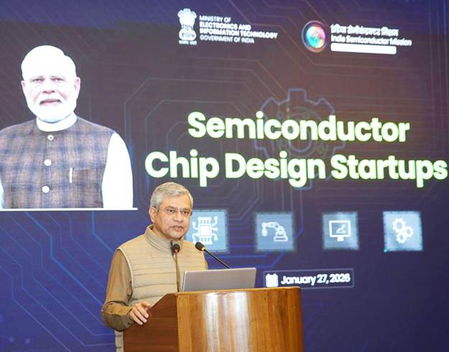
New Delhi, Jan 27 (IANS) Union Minister for Electronics and Information Technology Ashwini Vaishnaw on Tuesday said the government’s multi-year, ecosystem-driven approach to semiconductor development is delivering tangible results.
He said that India steadily moves towards building a strong and self-reliant chip design and manufacturing ecosystem.
Speaking after interacting with semiconductor chip design companies approved under the Design Linked Incentive (DLI) Scheme of the Semicon India Programme here, he said that the meeting focused on reviewing the progress of these companies, understanding their design innovations and reaffirming the government’s commitment to strengthening domestic semiconductor capabilities.
“The semiconductor programme was conceived in 2022 with a clear long-term vision laid down by Prime Minister Narendra Modi to build the entire semiconductor ecosystem, rather than implementing isolated schemes,” Vaishnaw said.
“The goal is to transform India from a services-led economy into a product-driven nation with strong capabilities in critical technologies,” he added.
Highlighting the success of the DLI Scheme, Vaishnaw said that while expectations were modest in the beginning, the programme now supports 24 startups.
“Several of these companies have already completed tape-outs, validated their products and gained market traction,” Vaishnaw stated.
“This has proven the effectiveness of the government’s approach of removing key hurdles faced by semiconductor startups by providing access to advanced design tools, IP libraries, wafer support and tape-out facilities,” he explained.
The Minister noted that the support being provided under the India Semiconductor Mission is among the most comprehensive in the world.
He said the government now plans to scale up the programme and enable at least 50 fabless semiconductor companies in the next phase.
“India is well on track to produce globally competitive fabless companies in the coming years,” Vaishnaw mentioned.
The DLI-supported companies are working across a wide range of semiconductor design areas, including indigenous system-on-chips and application-specific integrated circuits for surveillance, networking and embedded systems.
Their work also covers RISC-V based processors, AI-enabled low-power chips for IoT and edge applications, telecom and wireless chipsets, power management ICs, and solutions for strategic sectors such as automotive, energy, space and defence.
–IANS
pk