



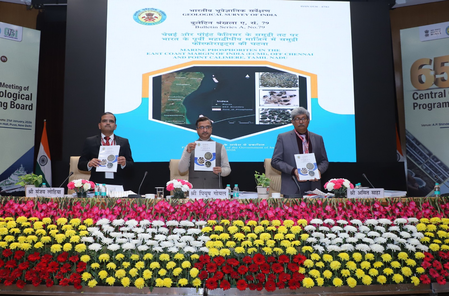
New Delhi, Jan 21 (IANS) Secretary, Ministry of Mines, Piyush Goyal said on Wednesday that the Geological Survey of India (GSI) will step up exploration efforts for critical and strategic minerals by taking up about 300 projects in 2026-27.
He directed the GSI to complete its active field season within a year, with the process of continuous rolling approvals of projects instead of annual approval, so that a prospective area can be explored as a whole.
Addressing the meeting of the Central Geological Programming Board (CGPB) here, the Secretary emphasised the adoption of a coordinated approach amongst all agencies to fast-track the exploration ecosystem in India.
During the meeting, the Geological Survey of India placed its Annual Programme for the upcoming field season 2026–27, comprising 1,068 scientific projects, before the Board for discussion. These exploration-related projects together account for about 55 per cent. GSI has also formulated about 37 projects in the international border region, which include 16 mineral exploration projects spread over Western, Eastern, Northern and North-Eastern Regions.
For the 2026–27 field season, a significant increase of about 46 per cent in G3 stage exploration projects reflects GSI’s strategic shift towards outcome-oriented, resource-bearing exploration. Further, a major thrust has been given to critical mineral exploration, with 236 projects formulated in this domain, showcasing GSI’s progressive and focused approach towards strengthening India’s critical mineral security, which will be further enhanced, according to an official statement issued by the Ministry of Mines.
In addition, GSI has outlined 144 projects under Natural Hazard Studies, Public Good Geoscience, and Fundamental Geoscience for Field Season 2026–27, covering landslide and geotechnical investigations, polar and glaciological research, climate change and environmental studies, along with core geoscientific research. These initiatives reaffirm GSI’s commitment to disaster risk reduction, climate resilience, and scientific innovation.
GSI has also formulated 58 Geoinformatics and Data Analysis projects for 2026-27, focusing on geospatial data generation, integration, analysis, dissemination, and management. These projects emphasise the use of advanced AI/ML modelling, legacy data integration, and emerging technologies to enhance exploration efficiency.
Further, GSI has proposed 160 training programmes across diverse themes for Training and Capacity Building of GSI personnel as well as stakeholders from Central Institutions, State Governments, PSUs, the private sector, and academia, reflecting its strong focus on human resource development and institutional strengthening.
In his welcome address, Asit Saha, Director General, Geological Survey of India, highlighted that the upcoming Annual Programme places strong emphasis on leveraging advanced geoscientific technologies, digital platforms and AI-enabled tools to accelerate mineral discovery, particularly of concealed and deep-seated deposits.
The Director General further highlighted that targeted exploration of critical and strategic minerals will significantly strengthen the country’s mineral security and support emerging sectors of the economy.
Sanjay Lohiya, Additional Secretary, Mines, in his address, underscored the importance of fast-tracking exploration work in the country. He directed GSI, NPEAs and other exploration agencies to complete the projects within the stipulated time. He informed that the agencies taking up exploration in any area may consult the National Geoscience Data Repository (NGDR) portal of the Ministry of Mines to avoid duplication of work.
He also urged State DGMs and all other stakeholders to upload their data to NGDR. He informed that the Ministry of Mines has formulated a policy for the recovery of critical and strategic minerals from ongoing exploration projects, existing mines and dumps, overburdens and tailings.
Lohiya requested all the stakeholders, including GSI, IBM, AMD, DAE, Ministry of Coal and State DGMs to adopt and implement the policy in their respective domains.
–IANS
sps/uk