



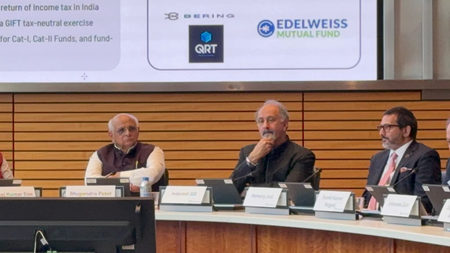
Washington, Aug 20 (IANS) Gujarat Chief Minister Bhupendra Patel has presented GIFT City as a global gateway for international capital flowing into India and invited global institutions to participate in the state’s next phase of financial and high-technology growth.
Addressing a high-level roundtable at the World Bank on Wednesday (local time), Patel said Gujarat was building a wider ecosystem around financial services, advanced manufacturing and emerging technologies. He highlighted the state’s semiconductor manufacturing plans and invited participants to visit GIFT City and attend the Vibrant Gujarat Global Summit 2027.
Patel said the state government was also expanding social infrastructure around GIFT City to create a vibrant and liveable business hub. The project would be presented to the world as a centre where financial institutions, technology companies and skilled professionals could work together, he said.
The meeting in the World Bank’s Shihata conference room was chaired by Indermit Gill, the World Bank Group’s Chief Economist and Senior Vice-President for Development Economics.
It brought together Gujarat Chief Secretary M.K. Das, GIFT City Managing Director and Group CEO Sanjay Kaul, World Bank Vice-President for South Asia Johannes Zutt, IFC Regional Vice-President for Asia and the Pacific Riccardo Puliti, MIGA Vice-President for Operations Junaid Kamal Ahmad and IMF Asia and Pacific Department Director Krishna Srinivasan.
Hemang Jani, the World Bank Executive Director representing India, Bangladesh, Bhutan and Sri Lanka, hosted the meeting. Gaurav Nayyar, director of the World Development Report 2026, also participated.
Jani described the meeting as a “landmark Roundtable on GIFT City.”
“The conversation reflected on Hon’ble PM Narendra Modi’s original vision for GIFT City not just as India’s first International Financial Services Centre, but as a genuine gateway connecting India’s capital markets to the world,” he said.
Presenting GIFT City’s progress, Kaul said its long-term appeal could not depend on fiscal incentives alone. “Ultimately, GIFT must compete on regulation, market debt, legal certainty, technology, talent, and of course, ease of doing business,” he said.
GIFT City now houses more than 1,200 entities registered with the International Financial Services Centres Authority, he said, adding that its banks held assets exceeding $111 billion as of March 2026, while its international stock exchanges record monthly turnover of more than $130 billion.
Kaul said the financial centre had crossed the proof-of-concept stage. Its next challenge was to develop deeper markets, more sophisticated instruments, greater institutional participation and substantially higher mobilisation of international capital.
“GIFT can become the platform connecting pension funds, sovereign funds, insurers, and local asset managers with Indian infrastructure, climate, manufacturing, and technology opportunities,” he said.
The presentation outlined opportunities in banking, fund management, insurance, aircraft leasing, fintech, capital markets and global capability centres. Gujarat officials sought cooperation from the World Bank Group on blended finance, guarantees, credit enhancement and sustainable urban infrastructure.
Zutt welcomed GIFT City’s progress but raised questions about the sustainability of its incentives and its ability to attract global talent.
“We’re very keen in the World Bank group to see the success of this particular initiative in Gujarat for the state and also for India more generally,” he said.
Zutt said schools, healthcare, housing and other social infrastructure would be essential to attract the professionals needed for GIFT City’s long-term success. He cited the World Bank’s experience with greenfield urban centres in East Asia, where liveability had emerged as an important factor in competitiveness.
The Gujarat delegation said GIFT City was expanding its social infrastructure. Its urban features include green building standards, district cooling, near-zero liquid discharge and automated waste management.
Puliti said GIFT City was already emerging as a channel for international capital entering India and the wider region.
“GIFT City will continue to be a major gateway for channelising that capital for the World Bank Group,” he said.
Puliti said financial institutions he met in Japan during the week had spoken about GIFT City’s growing importance to their Indian operations. He also outlined IFC transactions conducted through the centre.
The IFC has invested close to $400 million in multiple funds using GIFT City to attract global capital, Puliti said. The money has supported infrastructure, healthcare, consumer sectors, employment, productivity and financial inclusion.
Ahmad said GIFT City’s growth would also depend on changes in the way India finances infrastructure and integrates with international capital markets.
“You make India for the world. GIFT City will explode,” he said. “India’s market lies in the globe, not inside India. And GIFT City can play a major role in that.”
Ahmad said MIGA was exploring guarantees that could help capable Indian states raise long-term capital without a central government counter-guarantee. Gujarat, he said, was among the states well placed to consider such financing.
Srinivasan said the dialogue between Indian states and the central government would be important for improving the investment environment and deepening capital markets.
“If you look at FDI into India right now, it’s not very inspiring,” he said. The IMF could provide capacity-building support and facilitate discussions with the central government, he added.
Gill said the initiative faced a difficult global environment marked by slower emerging-market growth, weaker foreign investment flows and worsening trade conditions. Artificial intelligence, however, offered a major opportunity.
“For countries like India, for states like Gujarat especially, many of the preconditions for taking advantage of AI are already there in terms of the business sector,” Gill said.
Nayyar said developing countries should remain optimistic about artificial intelligence, adapt it to local conditions and make pragmatic policy choices. He said AI-assisted weather forecasts were already helping more than 30 million Indian farmers make production and investment decisions.
Gujarat International Finance Tec-City, located between Ahmedabad and Gandhinagar, was conceived when Prime Minister Narendra Modi was Gujarat’s chief minister. It combines an international financial services zone with a domestic business district and seeks to bring financial activity traditionally conducted overseas into India.
–IANS
lkj/sd/