




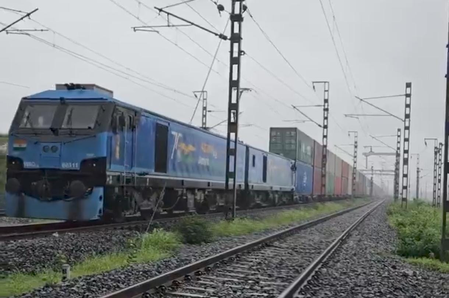
Vadodara, Aug 22 (IANS) Indian Railways has operated its first double-stack long-haul container train from Jawaharlal Nehru Port (JNPT) near Mumbai to CONCOR’s GCT terminal at Varnama in Vadodara division, carrying 360 TEUs over a distance of around 422 km.
The train departed from JNPT at 7 p.m. on August 21 and travelled on the Western Dedicated Freight Corridor, marking a significant expansion in the capacity for moving containerised freight in a single rail movement.
The long-haul formation consisted of two double-stack rakes coupled together. The leading rake, operating on the JNPT-Vadodara route, carried a load formation of 45+1 and was hauled by locomotive 60311, with a tonnage of 1,817 tonnes.
The trailing rake, also carrying 45+1, was hauled by locomotive 24690 and weighed 2,105 tonnes. Together, the two rakes transported 360 TEUs, with each rake carrying 180 TEUs.
The operation aims to improve container evacuation from JNPT and other freight terminals by moving a larger volume in a single train.
By consolidating freight into fewer train movements, long-haul double-stack operations can help reduce terminal congestion and the time containers spend awaiting evacuation.
The higher carrying capacity also reduces the rolling stock required to move an equivalent volume of freight. Fewer train movements for the same cargo volume can better use available route capacity, speed up container movement, and reduce overall transit time.
The operation also affects road freight transport. As an electrically hauled train, the movement reduces reliance on diesel-powered road transportation.
Transporting a large volume of containers in one train can reduce the number of trucks needed for an equivalent freight movement, thereby lowering diesel consumption, road congestion, and vehicular emissions.
The move comes as freight operations on India’s dedicated freight corridors increasingly focus on carrying larger volumes more efficiently.
The successful JNPT-Varnama run demonstrates the use of double-stack and long-haul formations to strengthen port-to-hinterland connectivity and increase the capacity of rail-based container logistics.
–IANS
mys/dan