



Gandhinagar, Oct 17 (IANS) Gujarat recorded its highest-ever electricity demand of 29,822 MW on October 16, a 36.6 per cent increase over the corresponding period last year, prompting the state government to step up power procurement and accelerate plans for battery storage, thermal generation and a nuclear power project.
The state’s daily electricity consumption also rose to 574 million units in October, compared with 457 million units in the same month last year, an increase of around 27 per cent.
Electricity demand during September and October has increased by approximately 12 per cent, or 4,000 MW, compared with previous years, according to the state Energy and Petrochemicals Department.
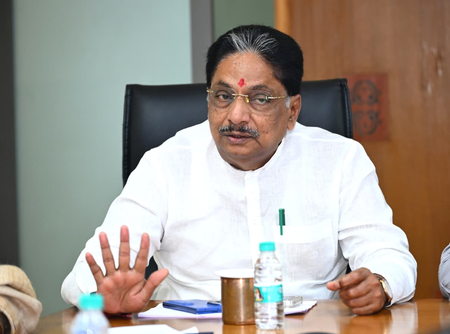
Energy Minister Rushikesh Patel and Minister of State, Kaushik Vekariya, reviewed the power supply situation with senior officials of the department and power companies in Gandhinagar on Saturday.
The meeting examined the reasons for the increase in demand, measures to ensure adequate supply and plans to meet future requirements.
Officials attributed the higher demand to continued high temperatures despite a weak monsoon, increased electricity consumption for agricultural irrigation, and higher industrial demand during Navratri and ahead of Diwali.
Adequate power supply to farmers for irrigating standing crops has pushed agricultural demand to a daily peak of 12,000 MW. Lower rainfall in Gujarat and neighbouring states has also reduced hydropower generation, which usually peaks in October and November.
Lower wind speeds have further curtailed wind power generation, adding to the pressure on the state’s electricity supply.
The challenge is particularly pronounced during the evening peak between 5 p.m. and 11 p.m., when solar generation falls to zero after sunset and wind power remains intermittent.
Coal- and gas-based power plants meet demand during these hours, while the State Load Dispatch Centre and distribution companies work to maintain grid frequency and balance.
To secure additional supplies, the state has held high-level meetings with the Centre to ensure adequate coal availability for the Gujarat State Electricity Corporation Ltd (GSECL).
The Union Ministry of Coal has assured 10–11 railway rakes of coal daily until November and 13–14 rakes daily from November onwards. Measures are also being taken to improve efficiency and optimise resources at state power stations.
The state has arranged to procure 379 MW from NTPC’s Farakka plant for November and 500 MW on a long-term basis from Assam’s share of central power generation, with the latter supply expected to begin shortly. Gujarat has also been allocated an additional 500 MW from the unallocated share of central power generation.
Short-term procurement arrangements have been made for 2,990 MW in October, 1,740 MW in November and 1,335 MW in December.
The government also plans to maximise the use of around 12,000 MW of solar power generated during daylight hours, with agricultural electricity consumption scheduled during these hours to make better use of available solar energy.
Battery energy storage systems (BESS) are being expanded to store solar power generated during the day for use during evening peak hours.
A capacity of 192 MW is currently operational, while contracts have been finalised for 2,742 MW, equivalent to 5,517 MWh of storage.
A further 500 MW/1,000 MWh is expected to become operational by March 2027, and a tender for 1,000 MW/4,000 MWh is under process.
For longer-term requirements, more than 1,300 MW has been allocated to Gujarat from central thermal generating stations. Supply is scheduled to begin in phases from 2027, with full availability expected in 2028–29.
Another allocation of more than 1,200 MW from central hydropower stations is expected to begin in phases from November 2026, with availability projected for 2028–29.
The state government has also sought an allocation of more than 5,000 MW from central thermal generating stations to meet projected demand in 2031–32.
Gujarat Urja Vikas Nigam Ltd (GUVNL) will soon issue a tender for 4,000 MW under the SHAKTI scheme, with power expected to become available from 2030–31.
An agreement has been signed with the Nuclear Power Corporation of India Ltd (NPCIL) for a 4,200 MW nuclear power project, with the first unit expected to become operational in 2032.
An 800 MW thermal power plant is under construction at Ukai and is expected to be commissioned by September 2029. The process of acquiring land and securing in-principle approvals for new thermal power projects at Sinor, Wanakbori and Gandhinagar is also under way.
The state government said power supplies were adequate to meet current demand and expected consumption to decline as weather conditions changed in the coming days.
It urged citizens to avoid rumours and electricity wastage, shift electricity-intensive activities to daylight hours wherever possible, and limit unnecessary consumption during the evening peak between 5 p.m. and 11 p.m.
–IANS
mys/dan