




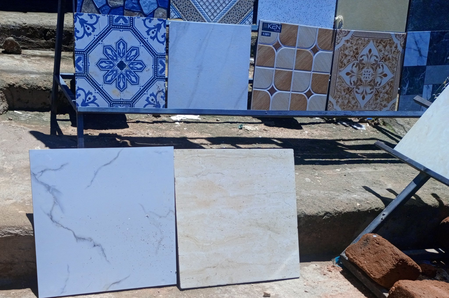
Morbi, Feb 16 (IANS) Gujarat’s Morbi district has emerged as the world’s second-largest ceramic manufacturing hub after China, with tiles produced in the town exported to markets across Asia, Africa, Europe, and the US, strengthening India’s position in the global ceramics trade.
Often described as the country’s ceramic capital, Morbi has witnessed rapid industrial expansion over the past decade.
Industry representatives say the cluster’s products now reach dozens of countries, reflecting its growing international presence and competitiveness.
Officials attribute the sector’s rise to sustained entrepreneurial investment supported by targeted state incentives.
S. B. Parejia, General Manager of the Morbi District Industry Centre, said ceramic manufacturers are eligible for a range of subsidies to encourage expansion and technological upgradation.
“These include interest subsidies and capital subsidies to ease the financial burden on units. Apart from this, if you participate in MDA’s showcase, for establishing your stall, you will get a subsidy,” he said.
Assistance is also provided for quality certification and obtaining power connections, he added.
The state government’s broader industrial framework, including initiatives under its Aatmanirbhar-oriented schemes, has been cited by industry bodies as a key factor behind the sector’s growth.
While certain policies are sector-specific, officials maintain that improvements in infrastructure and the ease of doing business have benefited manufacturing clusters across Gujarat, including the ceramics sector.
Morbi’s ceramic industry is estimated to generate employment for more than 5 lakh people, directly and indirectly, making it one of the largest employers in the region.
Manufacturers underline that uninterrupted access to gas and electricity remains essential for maintaining large-scale production.
Haresh Bopalia, President of the Floor Tiles Association in Morbi, said infrastructure support has been critical to the industry’s expansion.
“Whenever there’s development of any industry, the government fulfils the requirement of infrastructure and power. For the ceramic industry, gas and electricity are essential, and the government ensures availability,” he said.
Industrialist Arvind Vasdaria said the sector aligns with the national development vision articulated by Prime Minister Narendra Modi. “Prime Minister Narendra Modi’s vision for Viksit Bharat @2047 also includes the ceramic industry,” he said.
According to figures released by the state government ahead of the recent Vibrant Gujarat Regional Conference, Morbi accounted for approximately 80-90 per cent of India’s ceramic exports in 2024–25, with shipments valued at around Rs 15,000 crore.
Tiles and related ceramic products manufactured in the district account for a significant share of the country’s overall exports in this segment.
The cluster comprises an estimated 1,200 manufacturing units. Over the past two years, more than Rs 115 crore in financial assistance has been disbursed to over 2,200 beneficiaries under various state industrial incentive schemes, a government statement said.
Under the Aatmanirbhar Gujarat Schemes 2022 for Assistance to Industries, ceramic manufacturing has been identified as a thrust sector eligible for incentives, including interest subsidies on term loans and reimbursement of net State Goods and Services Tax (SGST) for qualifying units.
Additional benefits include reimbursement of employer statutory contributions and exemptions from electricity duty during the initial years of production.
The state has also developed dedicated infrastructure, including the GIDC Integrated Ceramic Park in the Morbi region, to support the value chain and promote advanced, high-value ceramic segments.
The facility is expected to offer logistical support, quality-testing infrastructure, and skilling initiatives.
With expanding exports, policy support, and infrastructure development, Morbi’s ceramic cluster continues to strengthen its global presence, positioning Gujarat as a key contributor to India’s manufacturing growth.
–IANS
mys/dan