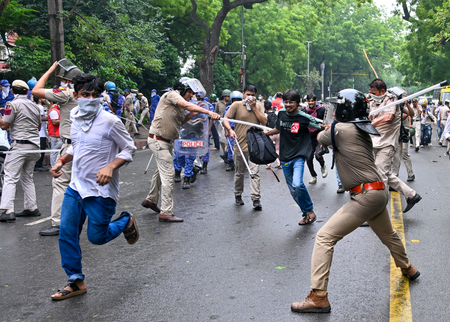
New Delhi, July 22 (IANS) The Delhi High Court on Wednesday issued notice to the Centre and the Delhi Police on a batch of public interest litigations (PILs) alleging excessive use of force by police during the recent CJP-led ‘Sansad Chalo’ march over the alleged NEET paper leak, while directing authorities to preserve CCTV footage, videography and other relevant records connected with the incident.
A Division Bench of Chief Justice Devendra Kumar Upadhyaya and Justice Tejas Karia observed that the allegations did not pertain to isolated incidents for which individual victims could simply be asked to lodge separate complaints, and sought responses from the authorities within four weeks.
In the meantime, the CJ Upadhyaya-led Bench directed preservation of “the relevant record in relation to the incident as mentioned in the writ petitions, including the CCTV footage, videography, if any”, in accordance with the standard operating procedures issued by the police.
The order came on the same day the Delhi High Court dismissed another PIL seeking a declaration that activist Sonam Wangchuk’s removal from Jantar Mantar on July 18 during his hunger strike was illegal, observing that Wangchuk’s wife had already approached the High Court in separate proceedings relating to his medical treatment and transfer to Medanta Hospital, and that the petitioner was free to avail remedies under the Bharatiya Nagarik Suraksha Sanhita (BNSS) to seek registration of an FIR.
Hearing the pleas relating to the July 20 protests, senior advocate N. Hariharan submitted that the students were peacefully exercising their constitutional rights under Articles 19 and 21 and alleged that the police resorted to “brutality of the highest order”. He argued that while the government could regulate assemblies, the force allegedly used against the protesters was wholly disproportionate.
“There are lathis with nails on them by which children are being beaten. Pellets and electric batons were used. This is the manner in which peaceful protests will be treated?” Hariharan argued. He further alleged that no proper warning or proclamation was made before force was used and claimed that more than 90 students had suffered injuries.
Hariharan also alleged that some women protesters were molested by policemen and urged the Delhi High Court to direct registration of FIRs against identifiable personnel besides ordering an independent investigation.
“At least the policemen who are identifiable, an FIR should be registered against them. There are policemen molesting women, using batons in their private parts. It is so ghastly,” he submitted, while also seeking preservation of CCTV footage, PCR logs, police directions authorising the use of force and other electronic evidence.
Senior advocate Gopal Sankaranarayanan, appearing in another PIL, submitted that after examining over 130 videos, his team found instances of excessive force, personnel without name tags and use of allegedly unauthorised weapons.
He referred to a video allegedly showing Additional DCP Sandeep Lamba slapping a woman protester without provocation and argued that the authorities had failed to follow the safeguards laid down by the Supreme Court in the Ram Lila Maidan case governing dispersal of assemblies.
Sankaranarayanan also contended that protesters, including women, mothers and family members, were subjected to tear gas despite there being only one water cannon at the site and sought registration of FIRs against the concerned police officials, departmental action and an independent judicial probe.
Senior advocate Vikas Singh argued that the march to Parliament had been publicly announced in advance and that the protest had remained peaceful until the police intervened. He submitted that there was nothing on record to indicate that the gathering had become an unlawful assembly and stressed that security personnel’s body cameras should be immediately seized.
“Hitting on the head can never be permitted under the law. Body cameras of security personnel should be immediately seized. This is a very very serious case where these innocent children and their families assembled there,” Singh said.
On the other hand, appearing for the Centre and Delhi Police, Additional Solicitor General S.V. Raju opposed the petitions, contending that they were based on social media videos and suppression of material facts. The Centre’s law officer submitted that prohibitory orders had been imposed, the crowd had turned violent, police personnel were injured, vehicles were damaged and videos showed incidents of stone-pelting.
“Though the petition looks impressive at the first blush, it is not so. These petitions are only publicity-seeking petitions so that they can get limelight. Persons allegedly beaten up have not come forward. These petitions do not even warrant a notice,” ASG Raju argued. He also contended that those alleging assault could avail statutory remedies before the Magistrate instead of invoking the Delhi High Court’s writ jurisdiction.
However, the CJ Upadhyaya-led Bench questioned the contention that each affected person should be relegated to filing separate complaints. “Was this an isolated incident? Perhaps no. If this was an unlawful assembly, there is a procedure to deal with it. If these issues are being raised in a PIL, how can you say every individual should go and lodge an FIR? Had it been an isolated incident, the situation would have been different,” the Delhi HC observed.
Clarifying that it was not expressing any opinion on the authenticity of the videos or the merits of the allegations, the CJ Upadhyaya-led Bench directed the respondents to file their counter affidavits within four weeks and granted the petitioners two weeks thereafter to file rejoinders. The matter has been listed for further hearing on September 11.
The petitions relate to police action during the CJP-led ‘Sansad Chalo’ march, in which students and other protesters attempted to march from Jantar Mantar towards Parliament over the alleged NEET paper leak. Delhi Police had erected barricades and imposed restrictions to prevent the march from proceeding beyond the designated protest site.
Following the protest, multiple FIRs were registered across central Delhi, including four at Parliament Street Police Station, three at Connaught Place Police Station and one each at Mandir Marg, Barakhamba Road and Kartavya Path police stations.
Meanwhile, the Supreme Court on Wednesday declined an urgent listing of a separate petition challenging the alleged police action against student protesters.
Refusing the oral mentioning, a Bench headed by Chief Justice of India (CJI) Surya Kant told the petitioner’s counsel: “Please don’t waste our time and don’t waste yours. Your time is more valuable than ours.” When the counsel referred to videos allegedly showing police brutality and sought an urgent hearing, the CJI remarked, “We are not interested in videos. We don’t have time to watch,” before declining the request for urgent listing.
–IANS
pds/uk