



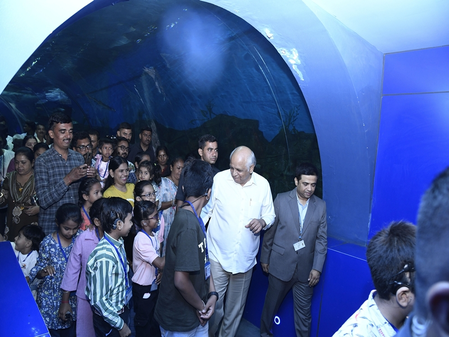
Ahmedabad, May 23 (IANS) At Ahmedabad’s Science City, children who had recently regained hearing and speech through Gujarat’s cochlear implant support programme met Chief Minister Bhupendra Patel in an interaction that brought together medical rehabilitation outcomes and personal milestones in child health care.
The visit took place at the Aquatic Gallery of Science City in Ahmedabad, where 20 children who had benefited from the state’s Cochlear Implant External Speech Processor Replacement Programme interacted with the Chief Minister during a guided tour.
The children, many of whom had previously been unable to speak, were seen conversing and responding with confidence following their treatment and rehabilitation.
Patel engaged with the children in a warm and informal manner, speaking with them individually and accompanying them through the facility.
Officials present said the Chief Minister’s interaction reflected a personal approach to the state’s child health initiatives, particularly those involving long-term treatment and rehabilitation.
The government programme under which the children received support provides cochlear implant surgeries free of cost to children up to six years of age diagnosed with profound hearing loss.
Initiated in 2014 under the School Health Programme, it has supported more than 3,500 children across Gujarat. Treatment is provided through a network of 10 hospitals across the state, ensuring access to specialised ENT care, audiology services and speech therapy.
The external speech processor component of the cochlear implant system, which is essential for converting sound into electrical signals for hearing perception, has also been included in the state’s support framework.
In 2024, the government introduced a policy to replace damaged, lost or non-functional external speech processors free of cost once for eligible beneficiaries.
According to official data, 401 children have received replacement devices so far. The cost of a single external speech processor is estimated at around Rs 3.5 lakh, a figure that places it beyond the reach of many families without state assistance.
During the interaction, parents shared accounts of diagnosis, treatment and rehabilitation under the public health system.
Many credited early screening through the Rashtriya Bal Swasthya Karyakram (RBSK) and subsequent treatment at government facilities for changing their children’s developmental outcomes.
Sonal Bhavsar said her child’s condition was identified during an Anganwadi screening, after which medical intervention was arranged at a government hospital.
“The government relieved us of the financial burden of treatment for our child born after 13 years of marriage. This support gave us both financial relief and emotional strength. Seeing the Chief Minister spend time with the children today has reassured us that he stands with families like ours,” she said.
Ritul Panchal described the experience of treatment for his daughter, Ruhi, who underwent surgery at Sola Civil Hospital.
He said the family had initially struggled with the high cost of private treatment before accessing the government scheme. “After a year of speech therapy, she is now able to speak clearly and attends school like any other child. This programme has given a new life to thousands of children. The Chief Minister met the children personally and treated them with great care and affection,” he noted.
Jainam Shah, another parent, said early diagnosis and intervention had enabled his daughter to integrate into mainstream education.
“She began speaking within months of therapy after her cochlear implant surgery. Today she studies in a regular school and leads a normal life. I would urge other parents not to delay or hesitate in seeking help through this scheme,” he said.
Officials said that the Chief Minister accompanied the children during the visit, where they observed marine life exhibits and participated in conversations encouraged by caregivers and therapists.
The interaction, they added, was intended to provide a relaxed environment for children undergoing rehabilitation.
The cochlear implant system consists of an internal implant and an external speech processor.
The external unit captures sound from the environment and transmits it to the internal implant, which converts it into electrical impulses sent to the brain’s auditory pathways.
Officials noted that the external processor typically has a lifespan of around 10 years and may require replacement due to wear and tear, moisture exposure, battery degradation or technical malfunction.
–IANS
mys/pgh