New Delhi, Dec 12 (IANS) Bangladesh’s transitional political phase has again come under question on the existing civil‑military balance, the legitimacy of the interim administration led by Muhammad Yunus, and the post‑election roadmap.
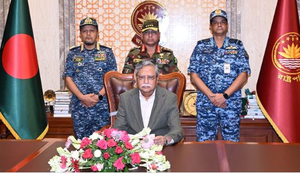
The existing chain of uncertainties arises from President Mohammed Shahabuddin announcing that he intends to resign after the February parliamentary election, citing the reasons of being repeatedly sidelined and “humiliated” by the Yunus-led interim administration.
The incumbent President was elected unopposed in 2023 as a nominee of the then-ruling Awami League.
Though seen largely as a ceremonial presidency, it became a focal constitutional office after the 2024 student uprising and the subsequent political upheaval that led to the dissolution of Parliament.
The office gained unusual prominence when long‑time Prime Minister Sheikh Hasina fled the country in August 2024, leaving Shahabuddin as the last standing constitutional authority in an uncertain, volatile period.
According to published reports and voices on the ground, the President felt humiliated and sidelined by the interim administration headed by a Nobel laureate. He has signalled his intention to step down after the general elections are held – as per official announcements – in February next year.
This decision, as he claimed, was in response to being repeatedly ignored and deprived of a meaningful role, even as the Presidency retained formal duties such as being commander‑in‑chief of the armed forces.
There exist pressures and insinuations that may explain Shahabuddin’s announcement.
First, as he indicated, institutional marginalisation, where, according to the reports, the Yunus interim cabinet appears to have exercised executive authority in a way that left the President politically isolated.
Second, following a popular unrest and legitimacy crises created through the student protests and street pressure, which repeatedly targeted the presidency and the old ruling party, and created an environment in which symbolic offices are contested.
Third, party realignment and legal constraints arising with the Awami League sidelined from contesting the upcoming polls have reshaped incentives for officeholders who were once allied with Hasina’s circle, making continued tenure politically fraught.
Shahabuddin’s announcement has activated political and diplomatic statements and counter-allegations.
The interim government will now want to project stability through the February vote, but the President’s untimely and controversial departure could be perceived domestically and internationally as evidence of a deep institutional discord rather than an orderly transition.
For the Opposition and other groups, the resignation may provide leverage to press for broader reforms, while remnants of the Awami League’s network will face pressure to recalibrate strategy if a figurehead they once trusted exits the stage.
As Bangladesh goes through a turbulent and fragile transition, a mid‑term presidential resignation carries several consequences. It risks further eroding public confidence in constitutional continuity at a moment when the legitimacy of the electoral process is already contested.
Additionally, it could prompt a reconfiguration of civil‑military relations: the President is the nominal commander‑in‑chief, and any vacuum or contested succession invites heightened attention from security institutions.
Moreover, the political signal matters for international partners watching stability and democratic credibility; donor and diplomatic responses will hinge on whether the February polls are seen as free, fair, and inclusive.
In the context of the developments, Shahabuddin’s decision to step down after the February election appears to be a personal protest that involves political alignment but also reflects Bangladesh’s fraught transition. It underscores reported institutional sidelining, political bitterness, and vicious confrontation, complicating the already delicate task of restoring stable governance after the 2024 upheaval.
How the interim government, political parties, and international observers respond in the coming weeks will determine whether the resignation precipitates deeper instability or becomes a managed change that helps reset Bangladesh’s political trajectory.
–IANS
jb/vd