



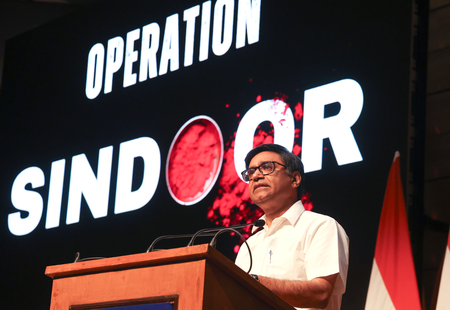
New Delhi, Dec 26 (IANS Operation Sindoor was a loud message that was sent out to Pakistan to avenge the horrific Pahalgam attack. While this strike by the Indian armed forces destroyed several terror camps and headquarters, apart from launch pads, the message to Pakistan was that any act of terror would no longer be considered as cross-border. It would be considered an act of war.
On the morning of May 7, the Indian armed forces announced Operation Sindoor hit terror infrastructure both in Pakistan-occupied Kashmir (PoK) and Pakistan. Among the major infrastructure to be destroyed was the headquarters of the Jaish-e-Mohammed in Bahawalpur and the Lashkar-e-Taiba’s top training facility in Muridke. Both terror groups and the Hizbul Mujahideen suffered immense losses both in terms of manpower and infrastructure, and are currently finding it extremely challenging to regroup.
With Operation Sindoor, India announced to the world that it had rewritten its doctrine that any act of terror would be considered an act of war. Experts say that such a response was the need of the hour. Pakistan would think twice before it carries out a strike in India, as it is aware that the response would be brutal. Such a response was needed to avenge such an audacious attack in Pahalgam carried out on April 22, in which 26 innocent lives were lost.
The idea of the ISI was to unleash the Lashkar-e-Taiba in Jammu and Kashmir to hurt the tourism industry, which has been booming since the abrogation of Article 370. Pakistan did manage to hurt the industry, but only briefly. Experts say that Operation Sindoor was not just about revenge and a strong message, but about the optics as well. The Pahalgam attack targeted only men, and they were all asked about their religion before being shot at point-blank range in front of their wives.
In the aftermath of Sindoor, two military women briefed the media. They told the media that the terror training camps were hit and how indigenously developed modern military equipment like Akash and BrahMos missiles were used. They also briefed about the real-time recordings of the attacks through modern technology.
Such briefings were important since there was a fake narrative being spread by the Pakistanis. They tried to project that this had won the duel, and it was India which suffered losses. The briefings, recordings and the proof dispelled all doubts, and Pakistan’s bluff was caught. Overall, Operation Sindoor was a demonstration of India’s military and strategic might. It was executed through a combination of both military and non-military means. It was a multi-dimensional operation which neutralised terrorists, deterred aggression by Pakistan and also enforced India’s zero-tolerance policy towards terror.
What is important is that the operation maintained strategic restraint while also gaining international support. After the Pahaglam attack, India was a nation that was seething with rage. Everyone wanted a strong response against Pakistan. It was one of the toughest periods that the Narendra Modi-led government had to endure.
One big challenge was that the people wanted quick action. However, Prime Minister Narendra Modi wanted decisive action and not a rushed one. He endured the pressure and gave the Indian armed forces a free hand. The gamble paid off, and under PM Modi’s leadership, India firmly established that terrorism and its sponsors will be treated alike. In the aftermath of the operation, PM Modi made it clear that a fitting reply would be given to terror. India will not tolerate any nuclear blackmail and terror camps being created, and it will hit back at any cost.
Further, Pakistan was told that there would be no difference between the government sponsoring terrorism and the masterminds of terrorism. The PM said, terror and talks will not go together; terror and trade cannot go on together; water and blood cannot flow together.
Operation Sindoor destroyed nine terror camps and conveyed that there would be equal punishment for terrorists and their sponsors. India also displayed air defence superiority, during which the indigenous Akashteer system shot down hundreds of drones and missiles. The strikes were precise without escalation, and during the operation on May 9-10, India carried out air strikes on 11 airbases of a nuclear-armed nation.
This led to the destruction of 20 per cent of Pakistan’s Air Force assets. High casualties were inflicted at the Bhoolari airbase. The strikes were coordinated and executed by tri-services — Army, Air Force and Navy. The impact of the operation was huge. The terror infrastructures in Pakistan are scrambling for funds, and many top leaders have gone underground. The likes of Hafiz Saeed and Masood Azhar are not visible and are probably underground.
In their absence, the terror infrastructure is finding it hard to restart. Azhar, the man behind the Parliament attack, Pulwama strike, among others, was the worst hit. Not only did he lose infrastructure, but a significant part of his family was wiped out. The strikes claimed the lives of high-value Jaish-e-Mohammed operatives such as Yusuf Azhar, Abdul Malik Rauf, and Mudassir Ahmad.
All these persons were involved in the IC-814 hijacking. The biggest hit has been in recruitment. In a nutshell, Operation Sindoor not just finished terror infrastructure, but destroyed the morale of the top terror leadership.
–IANS
vicky/skp