



New Delhi, May 15 (IANS) Researchers at Indian Institute of Technology Roorkee on Friday developed and released an open-access high-resolution climate projection dataset, named INDRA-CMIP6, aimed at helping India improve regional climate adaptation, disaster preparedness, and climate risk assessment.
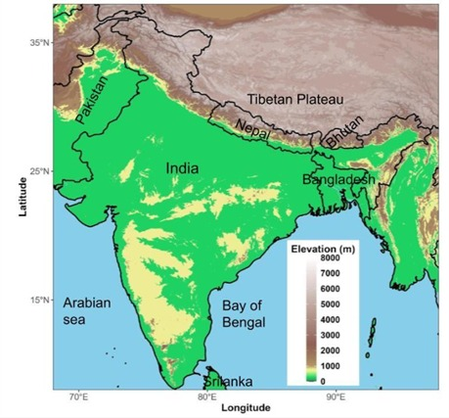
Developed by researchers from the Department of Hydrology at IIT Roorkee and published in the journal Nature Portfolio’s ‘Scientific Data’, the dataset provides daily rainfall and temperature projections for the Indian subcontinent at a spatial resolution of nearly 10 kilometres.
The initiative seeks to address a major challenge associated with global climate models, whose coarse-scale projections often fail to accurately represent India’s complex terrain, monsoon systems, and regional weather extremes.
India has been witnessing increasing impacts of climate change in recent years, including rising temperatures, erratic monsoon patterns, urban flooding, heat stress, and growing pressure on water resources.
Researchers said adaptation measures such as urban drainage planning, embankment strengthening, flood preparedness, and climate-resilient agriculture require climate projections at district and river-basin scales rather than broad continental averages.
The INDRA-CMIP6 dataset has been created using outputs from 14 CMIP6 global climate models through a statistical downscaling method known as Double Bias-Corrected Constructed Analogue (DBCCA).
According to the researchers, the approach improves the representation of daily weather variability, regional rainfall distribution, and temperature extremes across the Indian subcontinent.
The dataset includes daily precipitation, minimum temperature, and maximum temperature projections at a 0.1° × 0.1° resolution.
Researchers have also provided both individual climate model outputs and a multi-model ensemble, allowing users to compare different projections and evaluate uncertainty instead of relying on a single climate pathway.
Technical validation conducted by the research team showed that INDRA-CMIP6 significantly reduces systematic errors commonly found in raw global climate model outputs.
It also improves the simulation of extreme rainfall events and temperature extremes, which are particularly important for regions where local geography, monsoon behaviour, and topography strongly influence climate risks.
–IANS
pk